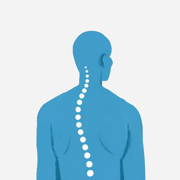
Good sleeping posture: what each position does to your spine
Good sleeping posture keeps your spine near the neutral curve it holds when you stand well. Back and side sleeping both allow that; stomach sleeping doesn't. Pillow height decides more than the position label does — the wrong loft undoes a good position either way.
What good sleeping posture means once you're horizontal
Upright, the spine stacks three curves: forward at the neck, backward through the ribcage, forward at the low back. Neutral spine is where each sits mid-range and the muscles holding them work least.
Lying down doesn't remove gravity, it turns it sideways. The mattress and pillow decide which curves get supported and which get pushed past their range, and you hold that decision for six to nine hours without the fidgeting a chair allows. A slouched desk hour ends when you stand up; a badly propped neck lasts until morning.
Two checks cover most of it: ear, shoulder, and hip on one line, and a chin that stays level.
Ranking the three sleeping positions
Rank by what each position asks of the neck and the lumbar curve and the order holds: back, side, stomach.
| Position | Neck | Lower back | Pillow setup | Main failure mode |
|---|---|---|---|---|
| Back | Neutral if loft is low | Neutral to slightly extended | Low under the head, one under the knees | Stacked pillows shove the chin toward the chest |
| Side | Neutral if loft fills the shoulder gap | Neutral while the pelvis stays square | Loft matched to shoulder width, pillow between the knees | Top leg slides forward and twists the pelvis |
| Stomach | Rotated near end range all night | Extended, more so on a soft mattress | None under the head, a thin one under the pelvis | The position itself — no neutral version exists |
Back sleeping: the neutral-spine default
Supine spreads your weight over the largest area and keeps both curves near where they sit when you stand. It fails in one predictable way: too much pillow. A tall stack pushes the head into flexion and parks the chin near the chest all night — the sleeping version of the forward-head position most desk workers already fight by day. If you're doing chin tucks and stacking two pillows at night, the pillows win on hours.
A back sleeper needs less loft than instinct suggests: enough to fill the hollow behind the neck, with the back of the head near mattress level. A pillow under the knees helps people whose low back aches lying flat — bending the hips and knees rotates the pelvis out of anterior tilt and shortens the lumbar arch.
One honest caveat: back sleeping worsens snoring and obstructive sleep apnea for many people, which is why positional advice for those points the other way.
Side sleeping: workable once the pillow fills the shoulder gap
Roll onto your side and a gap opens between your ear and the mattress, roughly as deep as your shoulder is wide. Fill it and the cervical spine stays level. Underfill it and the head sags, side-bending the neck for hours; overfill it and the head props the other way. Broad shoulders need considerably more pillow, which is why borrowing a partner's rarely works.
Below the waist, the problem is the top leg. Unsupported, it slides forward and down, pulling the hip into adduction and dragging the pelvis into a rotation the lumbar spine absorbs. A pillow between the knees, thick enough to hold that thigh roughly parallel to the mattress, keeps the pelvis square.
One more habit worth breaking: curling into a tight fetal shape rounds the thoracic spine and works against any progress on rounded shoulders.
Stomach sleeping: the neck holds a rotation all night
Prone is the one position with no neutral version. To breathe, the head has to turn, and most people can rotate the neck only about 70 to 90 degrees to a side — so a stomach sleeper spends the night near the end of that range. Extension stacks on top: the abdomen sinks into the mattress, more on a soft one, and the lumbar spine arches into the dip.
The tells: neck soreness always on the same side, morning stiffness that takes twenty minutes to clear.
If you're staying prone tonight, drop the head pillow — any loft adds extension to an already-rotated neck — and slide a thin one under the pelvis to flatten the lumbar arch.
Getting pillow height right for neck alignment
Picking a pillow for neck alignment is a measurement problem, not a comfort one. Comfort is the first thirty seconds; alignment is the next seven hours.
- Measure the gap, not the pillow. For side sleeping, the target loft is the distance from the base of the neck to the outer tip of the shoulder. Many adults land near four to six inches — a starting point, not a spec.
- Measure it compressed. Down and fiber fills lose much of their height within a minute, so judge loft after lying still, not on the shelf.
- Subtract for a soft mattress. A plush surface lets the shoulder sink and closes part of the gap, so the same person needs less pillow there.
- Have someone look. Head tipped up means too much pillow; tipped down means too little.
Persistent pain deserves better input than a pillow purchase. Pain that wakes you, numbness or tingling into an arm or leg, or stiffness that hasn't cleared half an hour after getting up belongs with a physician or physical therapist.
Leaving stomach sleeping without quitting cold
Telling a lifelong stomach sleeper to switch to their back mostly produces a lifelong stomach sleeper who is also tired. A transition position works better.
Start three-quarter prone: lie on your side, hug a body pillow against your chest, and draw the top knee up onto it. The chest ends up rotated partway toward the mattress — more than a full side-lying position, short of flat prone — which gives the pressed-into-the-bed feeling stomach sleepers are after while the head stays in line instead of turned. A second pillow behind your back stops the full roll-over.
Expect to wake up prone anyway for a couple of weeks. The habit is decided by the position you re-settle into after each wake-up, so the job is resetting, not getting it right once.
How to sleep to improve posture, realistically
Sleep doesn't build posture. Waking hours load the tissue that shapes it; the horizontal eight mostly decide whether you undo that work. The realistic target is neutral — waking without a stiff neck or a first hour spent undoing the night.
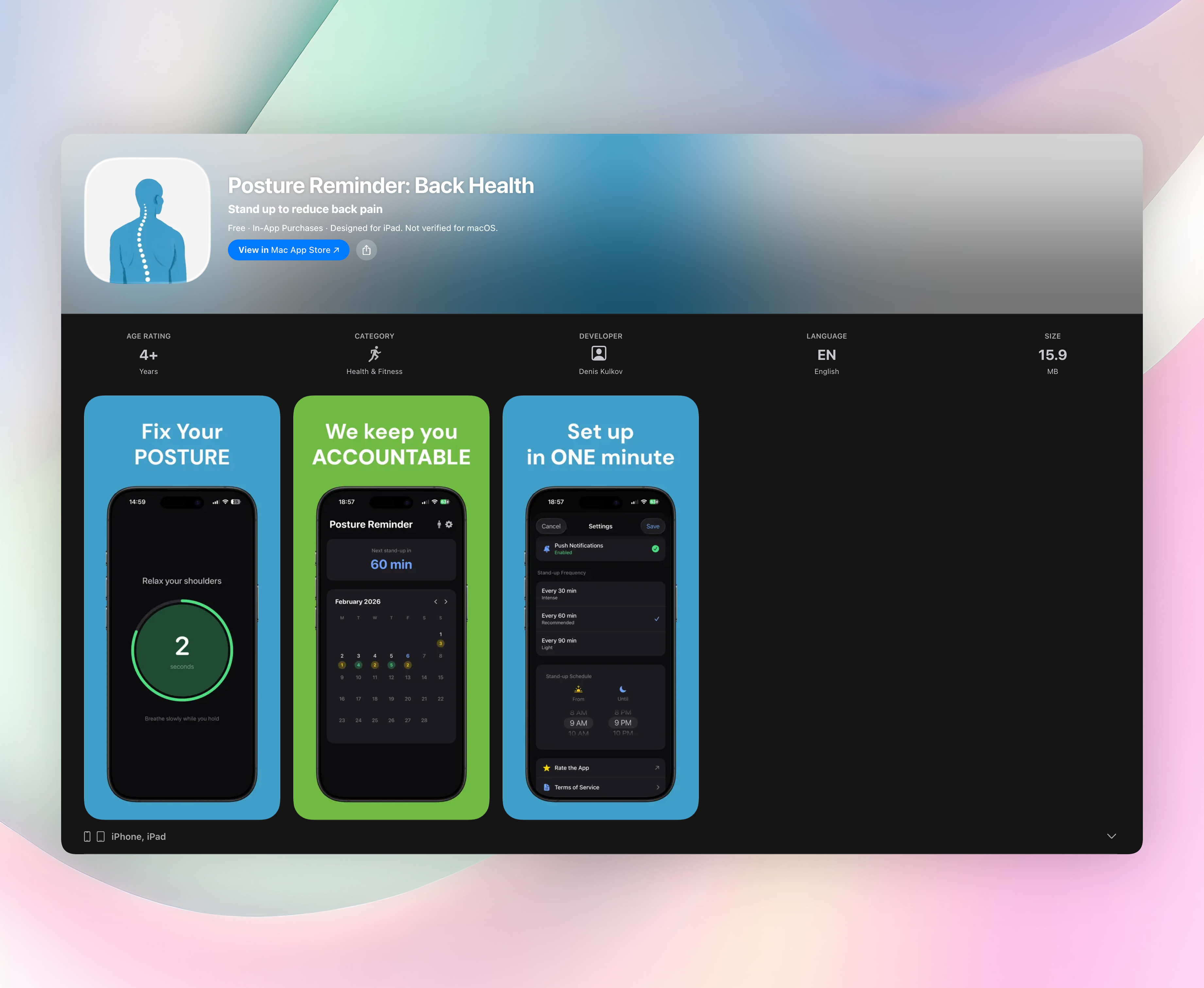
What makes it stick is a cue at a fixed time. Setting the bedroom up — the right pillow out, the knee pillow within reach — takes about a minute, and one-minute tasks are the ones that never happen without a prompt. Posture Reminder, a posture reminder app for iPhone and Apple Watch, runs daytime slouch checks on that same nudge mechanic; an evening wind-down reminder is the same mechanic pointed at bedtime.
FAQ
Is sleeping on your stomach bad for your back?
It's the hardest of the three on both ends of the spine — the lumbar curve held in extension by the mattress, the neck near the end of its rotation range for hours. If you can't change position, dropping the head pillow and adding a thin one under the pelvis eases both.
How to sleep with neck pain
The best sleeping position for neck comfort is usually the back with a low pillow, or the side with loft matched to shoulder width; both keep the neck out of side-bend and rotation. Stomach sleeping is the one to leave first. Pain that's persistent, one-sided, or comes with tingling into the arm should be assessed, not treated as a pillow problem.
What is the best sleeping position for lower back comfort?
Back sleeping with a pillow under the knees, or side sleeping with a pillow between the knees. Both stop the pelvis tilting or rotating, which is what the lumbar spine compensates for. Which feels better varies by person, so give each several nights.
How high should a side sleeper's pillow be?
High enough to fill the gap between the ear and the mattress once you're lying still — roughly the distance from the base of your neck to the point of your shoulder. Broad shoulders need more, a soft mattress less. The check is whether the head is level, not whether the pillow feels plush.
Can changing how I sleep improve my posture?
Not on its own. Posture is shaped mostly by what your waking hours load, so a forward head won't reverse overnight. A neutral setup stops adding to the problem for a third of every day, so the daytime work goes further.
Free Posture Reminder tools
- Anterior Pelvic Tilt TestThis anterior pelvic tilt test turns standing side-view observations into a simple posture score and neutral-position cues. It is a non-diagnostic screen, not a clinical assessment.
- Desk Chair Height CalculatorEstimate a desk chair height range from your height and desk height, then check whether your current chair supports a workable seated posture.
- Forward Head Posture CheckerUse a side-profile photo to estimate your craniovertebral angle with two clicks. This posture checker is a rough self-check, not a diagnosis.
- Monitor Height Ergonomics CalculatorEnter your seated eye height, monitor height, screen height and viewing distance to compare your setup with monitor height ergonomics targets.
- Posture Assessment ScoreAnswer a few desk posture questions, add your seated minutes and breaks, and get a non-diagnostic score with the highest-impact setup habits to review.
- Proper Sitting Posture at Desk CheckerCompare your desk, chair and monitor dimensions with height-scaled targets for a practical 90-90-90 sitting setup.
- Standing Desk Converter PlannerPlan a conversion standing desk setup from your body height, current desk, monitors and laptop. Get the converter lift, minimum surface width and estimated load.
- Standing Desk Height CalculatorEstimate a comfortable starting height for your standing desk, monitor, chair and screen viewing distance. Enter your body height and shoe heel height in centimetres or inches.
- Standing Desk TimerSet a sit/stand pattern and work-block length, then follow a live countdown with the next switch time, full schedule and sitting and standing totals.
- Wall Test Posture CheckUse a wall test for posture to record four contact findings and two gap measurements. Get a rough posture score, plain-language suggestions and the finding to address first.
- Workspace Ergonomics CalculatorUse an ergonomics calculator to set a desk or keyboard height, seat height, monitor top and viewing distance for seated or standing work.