Do posture correctors work, or just remind you to sit up?
A posture corrector holds your shoulders back while you wear it. Whether anything changes after you take it off is a separate question — and the honest answer to do posture correctors work is: as a reminder, yes; as a fix, no.
What a posture corrector actually does
Most over-the-counter correctors are soft: a figure-8 clavicle strap, an elastic shoulder harness, a vest-style brace. Mechanically they're one idea. Tension across the front of the shoulders draws the shoulder blades back, and the strap tightens the moment you round forward.
That second half is the part that matters. A soft strap can't reshape a thoracic spine, and it isn't lengthening tissue in the twenty minutes you have it on. What it reliably does is give you a tactile signal when you slump — proprioceptive feedback, the same category of intervention as a hand between your shoulder blades. Rigid orthoses fitted for scoliosis or prescribed after a fracture are a different category with their own evidence base — nothing sold online as a "posture corrector" belongs there.
Do posture correctors work once you take them off?
Here the marketing and the research part ways. Studies on posture straps tend to be small and short, and they measure posture while the strap is on — which mostly confirms that a strap does what a strap does. Follow-up showing durable change weeks later is scarce and low quality.
There's a deeper problem with the premise. Posture isn't a fixed structural trait waiting to be reset; it's a motor habit held up by muscular endurance and by how often you change position. Research linking spinal alignment to pain has grown more skeptical over time — measures like forward head position or thoracic curve turn out to be poor predictors of who actually hurts, while sustained static loading and a lack of movement variation predict discomfort better.
A device that alters your alignment for half an hour without touching your endurance or your movement habits has no obvious route to a lasting effect. The things that do change posture — strengthening the muscles behind rounded shoulders and moving more often — are the unglamorous ones.
Does a posture brace weaken the muscles it substitutes for?
The dependency worry deserves an honest answer: nobody has shown that a soft posture strap causes meaningful weakness at the doses people actually use. That cuts both ways — there's no evidence it's harmless at high doses either.
The reasoning is sound: when an external structure holds a position, the muscles that would hold it have less reason to fire, and unloaded muscle gets weaker. Whether that applies to a fabric strap worn 25 minutes a day is far less clear — it doesn't unload the postural muscles the way immobilization does.
Practically: short, deliberate sessions are unlikely to decondition anything. All-day wear for months is where the concern earns respect — and where the brace has stopped working as a reminder anyway, since a cue that never turns off stops registering.
How long to wear a posture corrector
Common practical guidance is 20 to 30 minutes a day, not all day. Start at 10 or 15 minutes and add time only if there's no next-morning soreness.
- Wear it during the task where you slouch most. If the problem is the third hour at your desk, that's when the cue earns its keep.
- Snug, not cranked. Straps tight enough to cause numbness or tingling down the arms are too tight.
- Correct with your own muscles. The point is to respond to the cue, not to hang on the strap.
- Fix the setup first. A monitor six inches too low will out-argue any brace; an ergonomic desk setup removes the reason you're slouching.
Pain, numbness, or tingling isn't a reason to tweak your wearing schedule — it's a reason to see a clinician.
Who actually gets posture corrector benefits
Three groups get real value: people who genuinely can't feel the slump, where a physical cue supplies the missing awareness; people in the first weeks of a habit change, using the brace as scaffolding; and people following a clinician's plan with a defined end date.
The people who don't benefit are the ones expecting the strap to do the work — worn all day, indefinitely, with no strength or movement change alongside it. Posture change runs on a slower clock than the packaging implies.
Three ways to remind yourself to sit up
| Approach | What it does | Cost | Holds up long-term? | Evidence quality |
|---|---|---|---|---|
| Posture brace | Tension you feel when you round forward | Typically $20–$60, one-time | Poor — most people abandon it within weeks | Weak; short studies, measured while worn |
| Timed cue (app, watch, or timer) | Prompts you to reset and move | Free to low | Good, if the interval is realistic | Indirect — rests on movement-break research |
| Environment change (desk, chair, monitor height) | Removes the reason you slouch | Varies; often free | Best — works whether you remember or not | Strongest of the three |
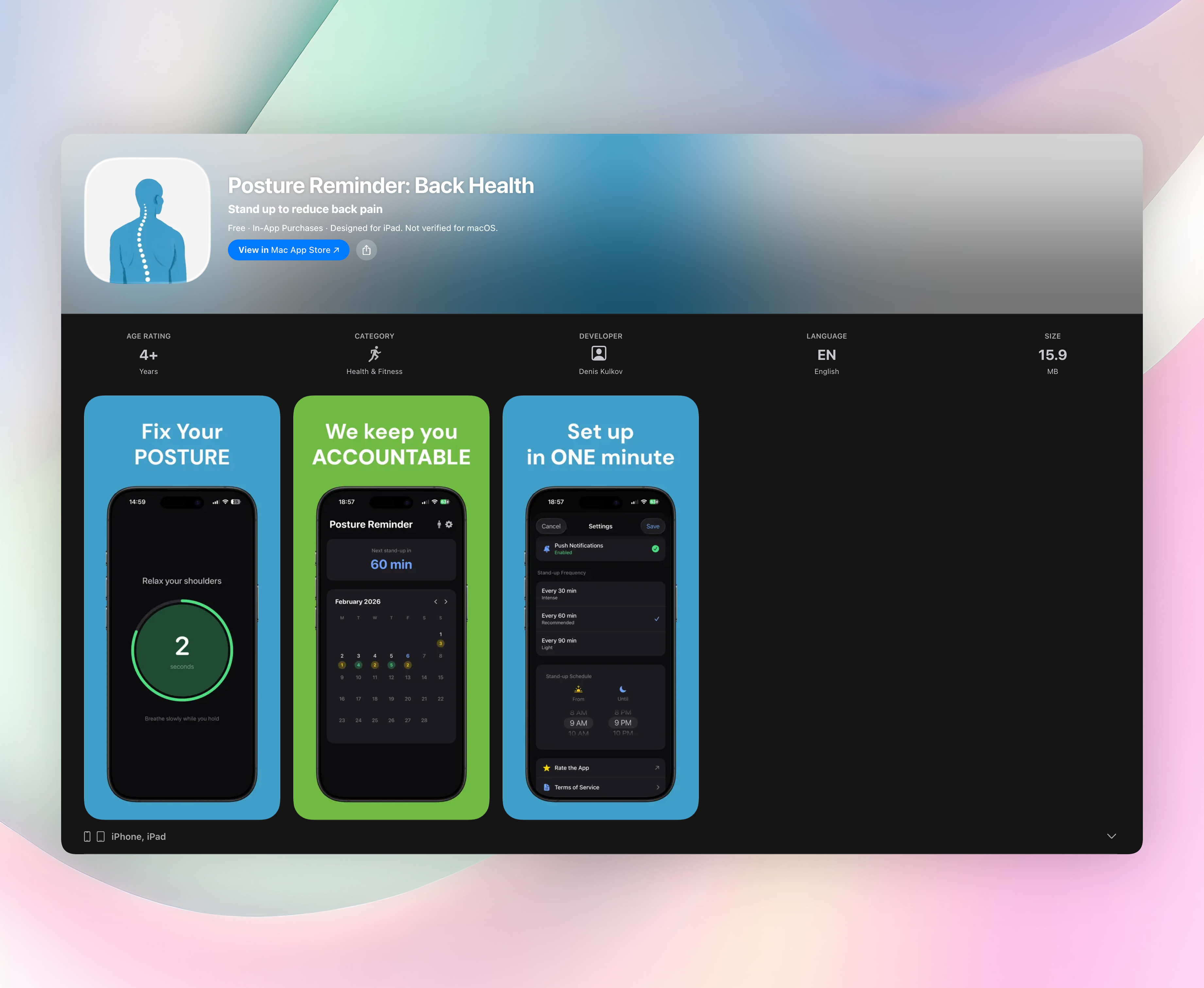
The brace and the timed cue differ in one way that matters: a brace holds the position for you; a cue prompts your own muscles to do it. The second is closer to what you're training, and easier to sustain because there's nothing to put on. Posture Reminder is a posture reminder app for iPhone and Apple Watch, which is one way to run that cue on an interval you pick.
These aren't exclusive: environment fix as the base layer, cues for the hours when it slips, a brace only if you can't feel the slump at all.
FAQ
Does a posture corrector work for rounded shoulders?
It'll pull them back while you wear it. Rounded shoulders usually come down to habit plus endurance in the mid-back muscles, and a strap addresses neither. Use it for awareness while you work on strength, not instead of it.
Does a posture brace work if I only wear it at my desk?
That's the better way to use one: the desk is where the slouching happens, so that's where the cue belongs. Keep sessions to 20 to 30 minutes rather than the full workday.
Can wearing a posture corrector make your posture worse?
No good evidence says it does at short daily doses. The realistic downside of all-day wear is that you stop noticing the cue — useless rather than harmful. Skin irritation and pressure from over-tightened straps are the more common complaints.
Are posture corrector benefits permanent?
Not from the brace itself. Whatever lasts comes from the strength and habit changes you make while using it. Remove those and posture drifts back to whatever your day encourages.
Free Posture Reminder tools
- Anterior Pelvic Tilt TestThis anterior pelvic tilt test turns standing side-view observations into a simple posture score and neutral-position cues. It is a non-diagnostic screen, not a clinical assessment.
- Desk Chair Height CalculatorEstimate a desk chair height range from your height and desk height, then check whether your current chair supports a workable seated posture.
- Forward Head Posture CheckerUse a side-profile photo to estimate your craniovertebral angle with two clicks. This posture checker is a rough self-check, not a diagnosis.
- Monitor Height Ergonomics CalculatorEnter your seated eye height, monitor height, screen height and viewing distance to compare your setup with monitor height ergonomics targets.
- Posture Assessment ScoreAnswer a few desk posture questions, add your seated minutes and breaks, and get a non-diagnostic score with the highest-impact setup habits to review.
- Proper Sitting Posture at Desk CheckerCompare your desk, chair and monitor dimensions with height-scaled targets for a practical 90-90-90 sitting setup.
- Standing Desk Converter PlannerPlan a conversion standing desk setup from your body height, current desk, monitors and laptop. Get the converter lift, minimum surface width and estimated load.
- Standing Desk Height CalculatorEstimate a comfortable starting height for your standing desk, monitor, chair and screen viewing distance. Enter your body height and shoe heel height in centimetres or inches.
- Standing Desk TimerSet a sit/stand pattern and work-block length, then follow a live countdown with the next switch time, full schedule and sitting and standing totals.
- Wall Test Posture CheckUse a wall test for posture to record four contact findings and two gap measurements. Get a rough posture score, plain-language suggestions and the finding to address first.
- Workspace Ergonomics CalculatorUse an ergonomics calculator to set a desk or keyboard height, seat height, monitor top and viewing distance for seated or standing work.