How long does it take to fix posture: three timelines, not one
How long does it take to fix posture? Flexibility changes in 2–6 weeks, strength in 6–12, and the habit that holds the new position takes a median of about 66 days. Anything genuinely structural doesn't reverse at all.
Three timelines hide inside "how long does it take to fix posture"
Posture isn't one project with one finish line — three adaptations, three clocks, finishing months apart.
| What's changing | Typical timeline | How you'd know it moved |
|---|---|---|
| Range of motion — chest, hip flexors, neck extensors | 2–6 weeks | The end position stops feeling like a stretch |
| Strength and endurance — deep neck flexors, mid-back, glutes | 6–12 weeks | You hold the position through a whole meeting |
| Habit and automaticity | Median around 66 days, wide spread | You catch yourself already upright |
| Bone and joint structure | No change after skeletal maturity | Imaging, not the mirror |
Range of motion: 2–6 weeks
Range moves first. Most people see a measurable change inside three to four weeks of near-daily work, and the curve flattens around six to eight.
What's changing early is mostly stretch tolerance — your nervous system raising the point where a position registers as uncomfortable, not the tissue itself getting longer. The joint still moves further, which is why the gain fades within weeks of stopping. General guidance is 15 to 30 seconds per stretch, several times, most days of the week.
Strength and endurance: 6–12 weeks
The first two to four weeks of strengthening are mostly neural — you're learning to recruit what you already have, not building tissue, which is why performance improves before anything looks different. Measurable muscle change generally needs six to ten weeks of consistent loading.
For posture the quality that matters is endurance, not peak strength. Nobody slouches for lack of force to sit upright — they slouch because the holding muscles fatigue and the skeleton takes over. That's a duration problem: longer holds, more sets, most days of the week. Endurance responds faster than size, which is why sitting tall can feel less effortful by week four. The mid-back and deep neck flexors are the usual weak links, a pattern known as upper crossed syndrome.
The habit: a median of 66 days, not 21
The 21-day figure traces back to a 1960 book by plastic surgeon Maxwell Maltz, who noticed patients seemed to need about three weeks to get used to a new face. It was an observation about adjustment, never a study of habit formation, and it's been repeated ever since.
The research that actually measured it is less convenient. Volunteers who picked one daily behavior and repeated it after a fixed cue reached their automaticity plateau at a median of about 66 days, spread from under three weeks to about eight months. So the honest answer to how long to form a habit is two to three months, and your own number could be double that.
Two details matter more than the median: the curve depends on the behavior firing after a consistent cue — same trigger, same context, every time — and missing the occasional day didn't visibly damage the trajectory, so a broken streak isn't a reset.
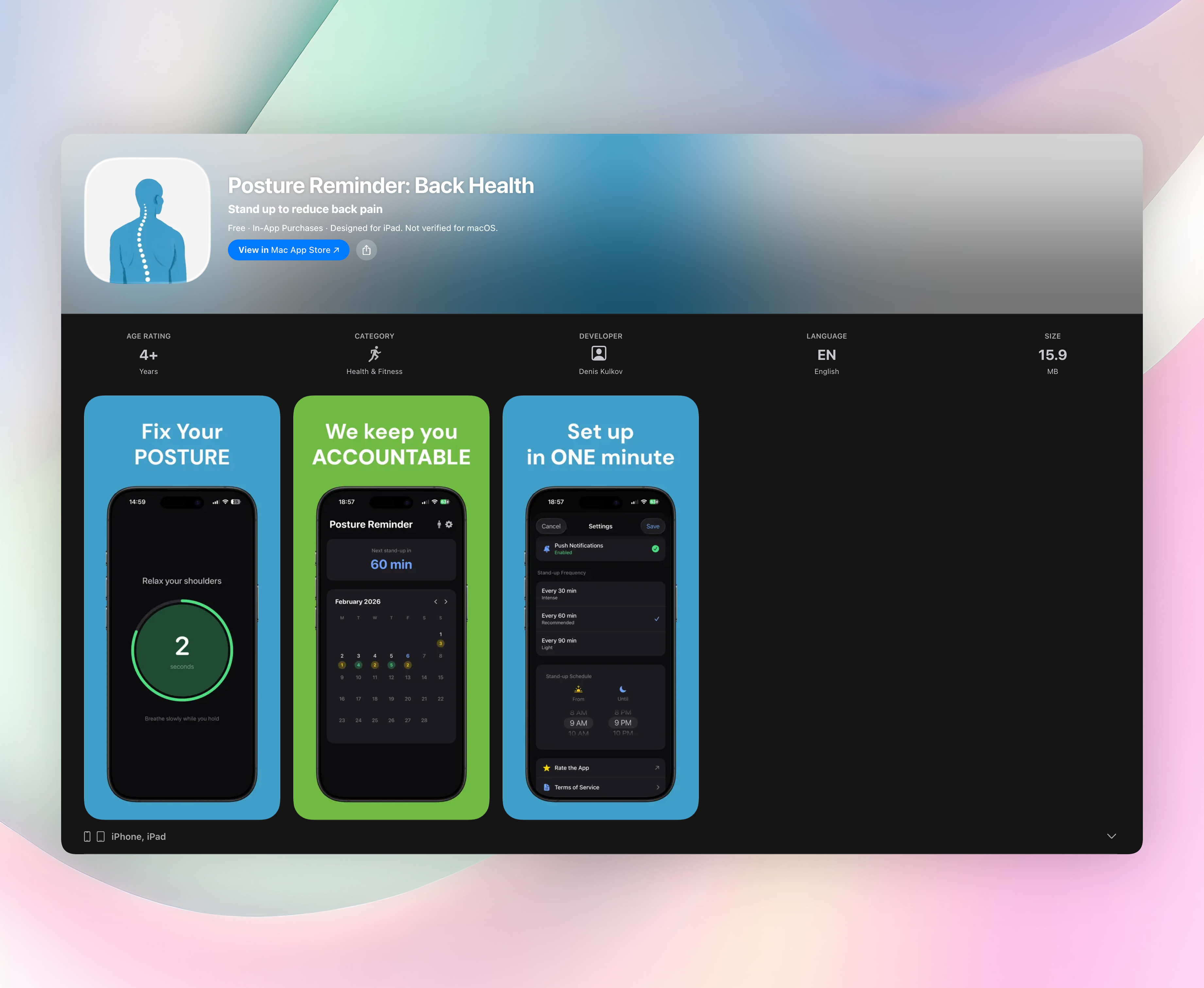
Posture's cue is the invisible one. Nothing about sitting down tells you to sit up, and the slide into a slouch happens gradually, below the threshold you'd notice. That's the gap an external cue fills — Posture Reminder is a posture reminder app for iPhone and Apple Watch, one way to make the cue fire on days nothing else reminds you.
Is bad posture permanent? What reverses and what doesn't
Almost everything people call bad posture is positional — a slouch, a forward head, rounded shoulders. Those are positions held by soft tissue and motor habit, and positions change at any age. That's the short answer to can bad posture be reversed: yes, when what you're reversing is a position.
Bone shape is the part that doesn't. Once the spine is skeletally mature, generally late teens to early twenties, vertebrae stop remodeling in response to how you sit. Wedged vertebrae from Scheuermann's kyphosis, a structural scoliosis curve, compression fractures from osteoporosis — that geometry is fixed.
Most real cases fall between. A neck hump is often part forward-head positioning and soft tissue, which responds, and part vertebral change, which doesn't, so it usually gets smaller without disappearing.
This is general ergonomics guidance, not medical advice, and posture is a weaker predictor of pain than it's usually made out to be — plenty of people with textbook-poor alignment have no symptoms. If you have pain, numbness, tingling, or a curve that's visibly changing, get assessed by a clinician instead of reasoning from a timeline.
Week-by-week: what changes when
- Weeks 1–2. Nothing visible. What changes is detection rate — you notice you've slouched, usually a few minutes after it happened. That count should climb before anything else improves.
- Weeks 3–6. Range. End positions stop feeling like stretches and standing tall takes less bracing.
- Weeks 6–12. Endurance. You hold the position through a meeting instead of the first few minutes of one.
- Weeks 8–14. Automaticity. You find yourself already upright without having decided to be — the stretch nearest the 66-day median.
- Month 4 on. Maintenance at a lower dose. Range regresses within weeks of stopping; the habit is more durable but still cue-dependent.
Re-measure every two weeks instead of checking the mirror
Posture varies with sleep, fatigue, and mood, so a single unflattering photo is noise. Fix the measurement and take it on a schedule.
- Wall test. Heels, buttocks, and upper back against a wall, eyes forward. Measure the gap between the back of your head and the wall in centimeters — the cheapest proxy for forward head posture, and sensitive enough to show movement across six weeks.
- Side photo. Same camera height and distance, feet on a marked spot, taken after walking a few steps rather than after posing. Compare ear position against the shoulder.
- Endurance timer. Time one hold — a wall angel, a prone hold — to form breakdown. This is where weeks 6 through 12 show up.
- Catch count. How often per day you notice a slouch. Expect it to rise for a month, then fall.
Two-week intervals, same time of day, same shoes. Measuring weekly mostly measures how you slept.
FAQ
How long does it take to correct posture if I only stretch?
Stretching alone moves range of motion in two to six weeks, and that's where it stops. Without strength work nothing holds the new range under load, so the position collapses the moment your attention goes elsewhere.
Is bad posture permanent after 40?
Positional posture isn't age-limited — soft tissue and motor habit respond in your forties much as in your twenties, with less margin for skipped weeks. Anything structural is fixed by then.
How long to fix forward head posture?
Range and awareness usually shift in three to six weeks. The endurance to hold a neutral head position through a full workday takes closer to three months. Verify with the wall test every two weeks, not daily mirror checks.
How many days to build a habit?
The habit research points to a median around 66 days with a wide spread — some people plateau in under three weeks, others take about eight months. Twenty-one days isn't a research finding; it came from a 1960 self-help book.
Can any of this be sped up?
Frequency helps, intensity mostly doesn't. Range and habit both respond to short near-daily exposure, and neither compresses if you double the volume twice a week instead.
Free Posture Reminder tools
- Anterior Pelvic Tilt TestThis anterior pelvic tilt test turns standing side-view observations into a simple posture score and neutral-position cues. It is a non-diagnostic screen, not a clinical assessment.
- Desk Chair Height CalculatorEstimate a desk chair height range from your height and desk height, then check whether your current chair supports a workable seated posture.
- Forward Head Posture CheckerUse a side-profile photo to estimate your craniovertebral angle with two clicks. This posture checker is a rough self-check, not a diagnosis.
- Monitor Height Ergonomics CalculatorEnter your seated eye height, monitor height, screen height and viewing distance to compare your setup with monitor height ergonomics targets.
- Posture Assessment ScoreAnswer a few desk posture questions, add your seated minutes and breaks, and get a non-diagnostic score with the highest-impact setup habits to review.
- Proper Sitting Posture at Desk CheckerCompare your desk, chair and monitor dimensions with height-scaled targets for a practical 90-90-90 sitting setup.
- Standing Desk Converter PlannerPlan a conversion standing desk setup from your body height, current desk, monitors and laptop. Get the converter lift, minimum surface width and estimated load.
- Standing Desk Height CalculatorEstimate a comfortable starting height for your standing desk, monitor, chair and screen viewing distance. Enter your body height and shoe heel height in centimetres or inches.
- Standing Desk TimerSet a sit/stand pattern and work-block length, then follow a live countdown with the next switch time, full schedule and sitting and standing totals.
- Wall Test Posture CheckUse a wall test for posture to record four contact findings and two gap measurements. Get a rough posture score, plain-language suggestions and the finding to address first.
- Workspace Ergonomics CalculatorUse an ergonomics calculator to set a desk or keyboard height, seat height, monitor top and viewing distance for seated or standing work.