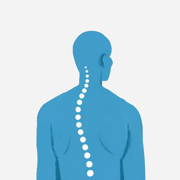
How to fix rounded shoulders, starting with the pec length test
Rounded shoulders usually come from one of two things: a short, tight chest pulling the shoulders forward, or an upper back too weak to hold them back. A two-minute test tells you which. Then you stretch, strengthen, or do both — in that order.
What rounded shoulders actually describe
The shoulder blades drift forward around the ribcage (protraction) and often tip forward at the top edge (anterior tilt), carrying the head of the upper arm bone with them. Quick check: stand relaxed and look at your palms. Facing your thighs is normal; facing behind you means the arms have rotated in and the blades have wandered.
How to fix rounded shoulders depends on which driver you have, because the two protocols pull in opposite directions — one adds length at the front, the other adds control at the back. The pattern also travels with forward head posture, and the two tend to improve together.
Posture varies a lot between healthy people, and a rounded look alone doesn't mean something is wrong — this is a mobility and strength question. If you have pain, numbness, or tingling down the arm, see a physical therapist or physician instead of self-programming around it.
The pec length test: tight front or weak back?
Lie face-up on a firm floor, not a mattress. Knees bent, feet flat, arms at your sides with palms up. Let everything settle for 30 seconds — people fake it by flattening on purpose. Then check the back of each shoulder: does it rest on the floor, or is there a gap? Run the second half by drawing the shoulder blades gently down into the floor and watching what the gap does.
| What you see | Likely driver | Where to spend your time |
|---|---|---|
| Shoulders rest flat and stay there when you relax | Neither, for now | Maintenance — keep loading the upper back |
| Gap stays even when you press the blades down | Short front (pec major and minor) | Stretch-led: doorway work first, strength after |
| Gap closes easily but returns the moment you relax | Weak or underused back | Strength-led: rows, scapular retraction exercises, wall angels |
| Gap closes partway, with effort | Both | Stretch, then strengthen, in the same session |
Check each side separately. Asymmetry is normal — the mouse-hand side is usually worse — and averaging both shoulders into one verdict hides it.
The doorway chest stretch at three arm heights
The pectoralis major's fibers run at different angles, so one arm position doesn't reach all of it. Use one forearm at a time on the frame; it's far easier to control than the both-arms version.
- Low — hand around chest height, elbow well below the shoulder. Biases the clavicular (upper) fibers.
- Middle — the goalpost: elbow bent 90°, hand at shoulder height. Biases the sternal fibers, the bulk of the muscle.
- High — hand above head height, elbow bent open past 90°. Biases the lower fibers and asks more of the front of the shoulder capsule, so go lightest here.
Step through with the same-side foot, keep the ribs down instead of arching your low back to fake range, and rotate your chest away from the arm. Thirty to sixty seconds per position is the usual prescription, and a firm pull is enough — pain isn't the target.
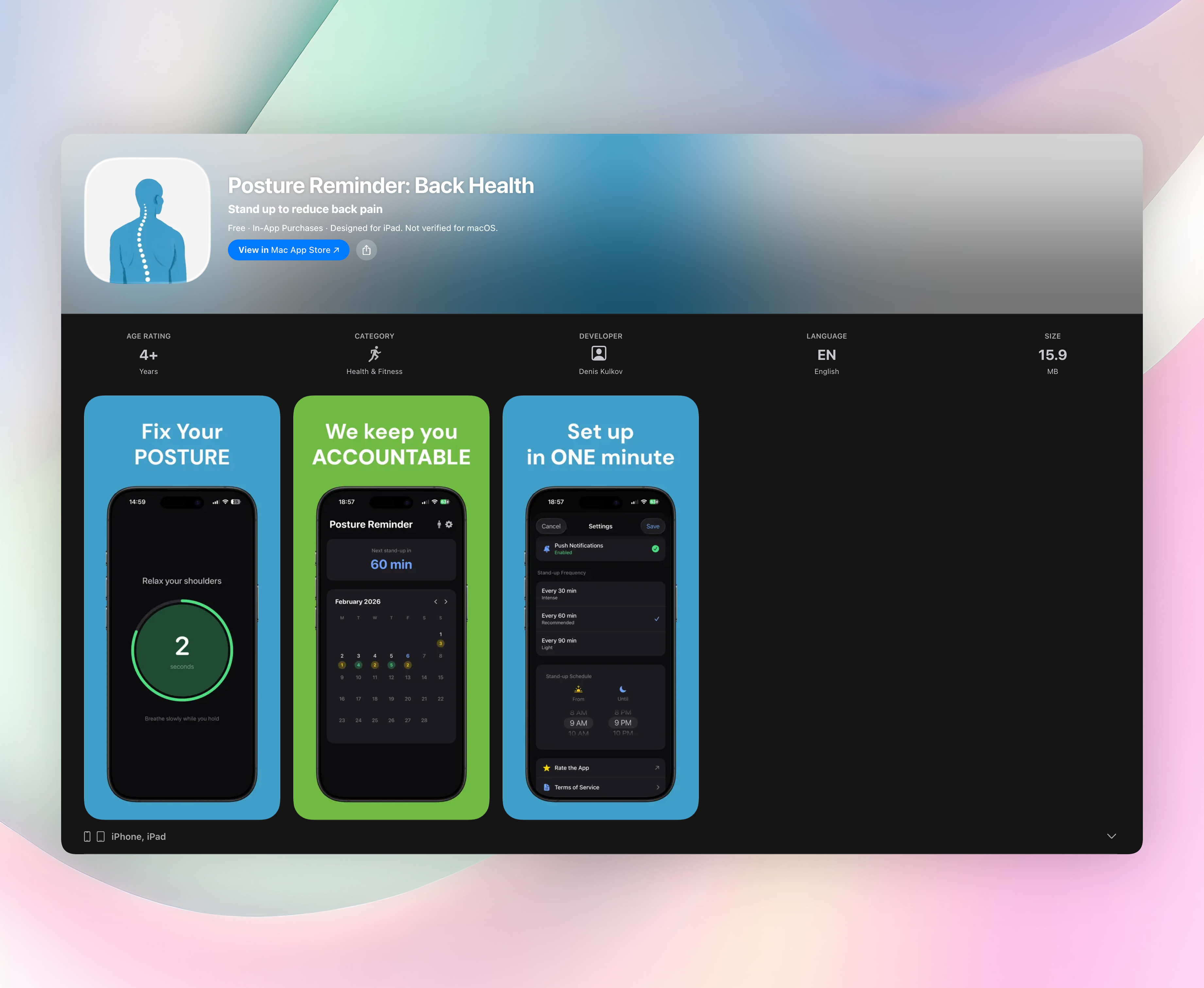
The real limit on any pec stretch is how long the effect survives. Whatever length you gain from a 60-second hold starts giving itself back once you sit down and the shoulders re-shorten over the next few hours at a keyboard. That makes spacing more useful than duration: three short doorway holds scattered through the workday beat one long session at 6 p.m. Posture Reminder is a posture reminder app for iPhone and Apple Watch, which is a practical way to make that spacing actually happen.
Scapular retraction exercises that don't turn into shrugs
"Squeeze your shoulder blades together" is where most upper-back work goes wrong. Cued that way, the shoulders ride toward the ears and the upper traps and levator scapulae take over — the same muscles already overworking in the upper crossed syndrome pattern, so you reinforce the thing you're trying to change. Three corrections:
- Down before back. Set the blades down toward your back pockets, then bring them together. If the top of the shoulder rises, the rep is wrong.
- Slow it down. Two seconds in, a two-second hold, two seconds out. Speed hides the shrug.
- Pick movements that punish cheating. Prone Y and T raises with thumbs up, face down on the floor. Band pull-aparts at chest height. Rows finished by driving the elbow back rather than pulling with the biceps.
Two or three sets of 10 to 15 reps, three or four days a week, is a reasonable starting dose for rounded shoulders exercises.
The wall angel exercise and the standard most people fail
Heels four to six inches off the wall, knees soft, sacrum, upper back, and the back of the head all in contact. The low-back gap should take a flat hand, not a fist. Bring the arms into a goalpost with elbows, forearms, and the backs of the hands on the wall.
The standard: slide up and down while every contact point holds and the low-back gap doesn't grow. It breaks in three predictable ways — ribs flare and the low back arches, the head pokes forward off the wall, or the wrists peel away near the top. Any of those and the rep stopped training what you wanted.
Don't push through it. Shorten the range instead, sliding only as far as contact survives — for a lot of desk workers that's a few inches. Two sets of eight to ten slow reps. If the backs of your hands won't reach the wall at shoulder height at all, that's a length problem, not an effort problem.
Fitting it into a week
Short daily stretch bouts, upper-back strength three or four days a week, and a workstation that isn't fighting you. The third outranks the other two by sheer hours: no stretch outlasts a day at a monitor that's too low, so get the ergonomic desk setup sorted first. Give it weeks rather than days — resting posture follows capacity, and capacity moves slowly.
FAQ
How long does it take to fix rounded shoulders?
Chest range of motion often improves within two to three weeks of daily stretching. How you stand when you're not thinking about it takes longer, since that follows upper-back strength and desk habits rather than flexibility. Judge progress by re-running the pec length test, not by mirror checks.
Do posture correctors or braces work?
A brace works as a tactile reminder — it tells you when you've drifted. It doesn't lengthen a short pec or build a stronger upper back, so whatever it does tends to stop when it comes off. Use it as a cue alongside the work, not instead of it.
Is the doorway stretch safe if my shoulder clicks?
Painless clicking is common and usually not a concern on its own. Sharp pain, catching, or tingling down the arm is a reason to lower the arm height and ease off the lean — and to get the shoulder assessed if it keeps happening.
Can I do any of this at my desk?
Yes. Band pull-aparts, seated scapular sets, and chin tucks all work in a chair, and a door frame is rarely far away. What doesn't work is saving it all for one block at the end of the day — the point is interrupting long stretches in the same position.
Free Posture Reminder tools
- Anterior Pelvic Tilt TestThis anterior pelvic tilt test turns standing side-view observations into a simple posture score and neutral-position cues. It is a non-diagnostic screen, not a clinical assessment.
- Desk Chair Height CalculatorEstimate a desk chair height range from your height and desk height, then check whether your current chair supports a workable seated posture.
- Forward Head Posture CheckerUse a side-profile photo to estimate your craniovertebral angle with two clicks. This posture checker is a rough self-check, not a diagnosis.
- Monitor Height Ergonomics CalculatorEnter your seated eye height, monitor height, screen height and viewing distance to compare your setup with monitor height ergonomics targets.
- Posture Assessment ScoreAnswer a few desk posture questions, add your seated minutes and breaks, and get a non-diagnostic score with the highest-impact setup habits to review.
- Proper Sitting Posture at Desk CheckerCompare your desk, chair and monitor dimensions with height-scaled targets for a practical 90-90-90 sitting setup.
- Standing Desk Converter PlannerPlan a conversion standing desk setup from your body height, current desk, monitors and laptop. Get the converter lift, minimum surface width and estimated load.
- Standing Desk Height CalculatorEstimate a comfortable starting height for your standing desk, monitor, chair and screen viewing distance. Enter your body height and shoe heel height in centimetres or inches.
- Standing Desk TimerSet a sit/stand pattern and work-block length, then follow a live countdown with the next switch time, full schedule and sitting and standing totals.
- Wall Test Posture CheckUse a wall test for posture to record four contact findings and two gap measurements. Get a rough posture score, plain-language suggestions and the finding to address first.
- Workspace Ergonomics CalculatorUse an ergonomics calculator to set a desk or keyboard height, seat height, monitor top and viewing distance for seated or standing work.