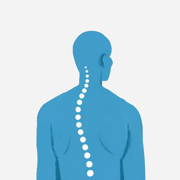
Neutral spine and what good posture actually means
A neutral spine is your spine's naturally curved resting position: a slight inward curve at the neck, a gentle outward curve through the mid-back, and a modest inward curve at the low back. Good posture means living near that range — not locking into one upright pose and holding it.
What a neutral spine actually is
Your spine isn't a column. Viewed from the side it has three working curves, and neutral means all three sit inside their normal range at the same time.
- Cervical lordosis — the neck curves gently forward. The skull balances over it rather than hanging in front of it.
- Thoracic kyphosis — the rib cage section curves backward. Measured on a side-view X-ray between roughly T5 and T12, values in the 20–45 degree range are typically considered normal, though the exact cutoffs differ by measurement method and drift upward with age.
- Lumbar lordosis — the low back curves forward again, commonly reported somewhere around 40–60 degrees, with wide individual variation.
Underneath all three sits the pelvis. Tip it forward and the lumbar curve deepens; tuck it under and the curve flattens and the mid-back rounds to compensate. The pelvis is the dial that sets the other two, which is why any honest posture assessment starts there rather than at the shoulders.
Those numbers are context, not a target — nobody measures their own Cobb angle at a desk. What they tell you is that neutral is a band with real width. Two healthy people can differ by 20 degrees and both be fine.
What is good posture, if it isn't a pose?
Good posture is a position range you can move in and out of, plus enough endurance to return to it. The stiff military stance — chest thrown up, chin tucked hard, shoulders yanked back — is not neutral. It overshoots the lumbar curve and costs energy you can't spend for eight hours.
Practical signs of good posture, standing:
- Ribs stacked over the pelvis, not flared forward or slumped behind it
- Ears roughly over the mid-shoulder
- Weight through the middle of the foot, not jammed into heels or toes
- You can take a full, quiet breath into the lower ribs
- You can rotate your head and torso freely from the position
The last two matter most. If a posture blocks your breath or your rotation, you're bracing, not stacking.
The ear–shoulder–hip landmark check
This is the fastest posture test there is, and it needs one photo. From the side, a vertical reference line through a relaxed standing body passes near a predictable set of landmarks:
- The earhole
- The point of the shoulder (acromion)
- The greater trochanter — the bony bump on the outside of the hip
- Just in front of the middle of the knee
- Just in front of the outer ankle bone
Set your phone at hip height about eight to ten feet away, stand relaxed with your side to the camera, look straight ahead, breathe out twice, then take the shot. Draw a vertical line in any photo editor from the ankle landmark upward.
Read the offsets, not a pass/fail. If the ear sits well forward of the shoulder, that's forward head position — clinicians quantify it as the craniovertebral angle, and the thresholds used in research vary, so treat a photo as a trend line rather than a diagnosis. If the hip sits forward of the line and the ribs sit behind it, you're swaying rather than stacking.
The posture wall test: three points, 30 seconds
The wall test turns the same idea into something you can feel. Stand with your heels roughly two to four inches from a flat wall — some versions put the heels against the wall, which is stricter and harder on tight ankles. Let your arms hang. Chin level, eyes forward.
Three points should touch the wall at once:
- The back of your head
- Your shoulder blades
- Your sacrum and buttocks
Then check the two gaps. Slide a flat hand behind your low back: the back of your hand should meet the wall with the gap feeling snug, roughly the depth of your palm. Behind your neck, expect a gap of about one to two inches.
Pass means all three points touch without you lifting your chin, hollowing your low back, or holding your breath — and that you can stay there for 30 seconds breathing normally.
What each failure points to
| What you find | Common pattern | What it points to |
|---|---|---|
| Head only touches if you tip your chin up | Forward head position | Neck extensor tightness plus a stiff upper thoracic segment |
| Neck gap wider than about two inches | Forward head position | Same, further along |
| Shoulder blades won't rest flat | Rounded, protracted shoulders | Tight chest and limited thoracic extension |
| A whole hand slides through behind the low back with room left | Deeper lumbar curve, pelvis tipped forward | Hip flexor tension, weak anterior core |
| No room for a hand at all | Flattened lumbar curve, pelvis tucked under | Habitual tucking, often from long sitting |
| Everything touches but you can't last 30 seconds | Range is fine, endurance isn't | Postural muscles, not mobility, are the limit |
Two notes on interpretation. Failing one point is common and by itself means very little. And the test is affected by footwear, so run it barefoot every time or the result moves for reasons that have nothing to do with your spine.
What the wall test can't see
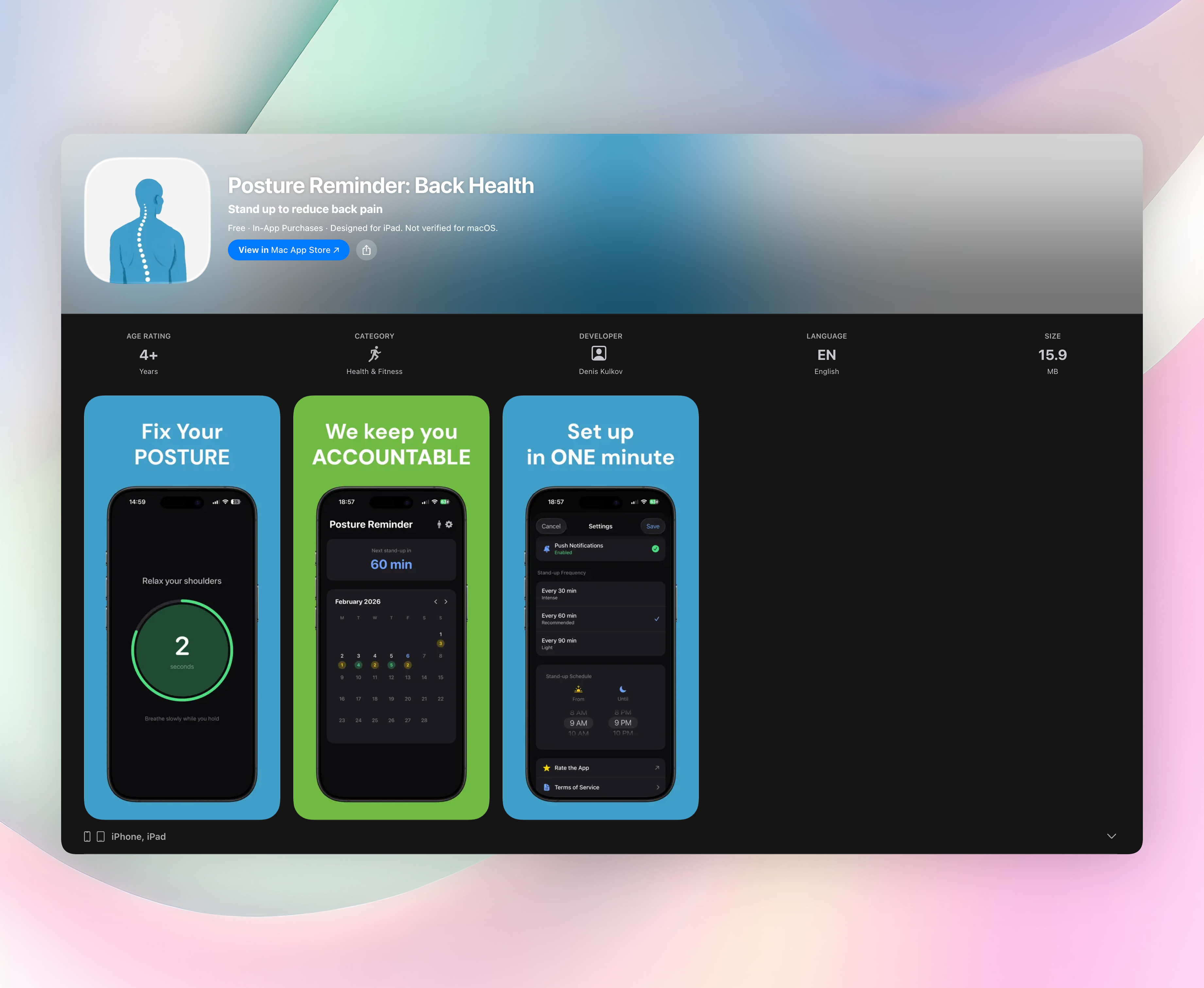
A wall test is one frame out of a very long day, and it measures the easiest thirty seconds you'll spend — the ones where you're paying attention. The real question is what your spine does during the other eight desk hours, when drift happens on a timescale you stop noticing. Posture Reminder is a posture reminder app for iPhone and Apple Watch, one way to turn the single check you just ran into something that repeats through the day.
Your baseline worksheet
Before changing anything, get a number. Write these down with today's date, barefoot, at the same time of day — height and disc hydration shift over a day, so a morning test and an evening test aren't comparable.
- Head contact — touches freely, touches only with a chin lift, or won't touch
- Neck gap — inches, measured with fingers stacked flat against the wall
- Shoulder blade contact — both flat, one flat, or neither
- Low-back gap — fingers only, flat palm, or palm with room to spare
- Hold time — seconds until you have to break the position
- Side photo — how far forward of the shoulder the ear sits, in finger widths
- Sitting check — the same ear-over-shoulder read taken at your desk, mid-afternoon
Seven values, three minutes, one line of a notebook — and the only thing that will tell you later whether anything you changed worked.
Retest every four weeks under the same conditions. Progress usually shows up as hold time first, then gaps, then the photo. If any position causes pain, numbness, or tingling, stop and see a physical therapist or physician; everything here is general ergonomic guidance for healthy adults, not a diagnosis or treatment plan.
FAQ
How do I know if I have bad posture?
Run the wall test and the side photo, then look for a consistent story across both. A head that only reaches the wall with a chin lift plus an ear sitting clearly forward of the shoulder in the photo is a real finding. One borderline result on one test isn't.
Does failing the wall test mean my posture is bad?
No. The wall test measures whether you can reach a neutral position right now, and it's affected by shoes, ankle mobility, and how you're standing that minute. Treat a failure as a starting number to improve, not a label.
Is a completely straight back good posture?
No — a flat spine is its own deviation. The three curves absorb load and let the spine flex. Standing so upright that your low back flattens out replaces one imbalance with another.
How long should I hold a neutral spine while sitting?
You shouldn't hold anything indefinitely. The realistic target is returning to neutral often rather than staying there, which is why changing position every 20 to 30 minutes tends to feel better than any single "correct" chair setup.
How often should I redo the posture assessment?
Every four weeks is enough to see change without chasing daily noise. Same time of day, barefoot, same wall.
Free Posture Reminder tools
- Anterior Pelvic Tilt TestThis anterior pelvic tilt test turns standing side-view observations into a simple posture score and neutral-position cues. It is a non-diagnostic screen, not a clinical assessment.
- Desk Chair Height CalculatorEstimate a desk chair height range from your height and desk height, then check whether your current chair supports a workable seated posture.
- Forward Head Posture CheckerUse a side-profile photo to estimate your craniovertebral angle with two clicks. This posture checker is a rough self-check, not a diagnosis.
- Monitor Height Ergonomics CalculatorEnter your seated eye height, monitor height, screen height and viewing distance to compare your setup with monitor height ergonomics targets.
- Posture Assessment ScoreAnswer a few desk posture questions, add your seated minutes and breaks, and get a non-diagnostic score with the highest-impact setup habits to review.
- Proper Sitting Posture at Desk CheckerCompare your desk, chair and monitor dimensions with height-scaled targets for a practical 90-90-90 sitting setup.
- Standing Desk Converter PlannerPlan a conversion standing desk setup from your body height, current desk, monitors and laptop. Get the converter lift, minimum surface width and estimated load.
- Standing Desk Height CalculatorEstimate a comfortable starting height for your standing desk, monitor, chair and screen viewing distance. Enter your body height and shoe heel height in centimetres or inches.
- Standing Desk TimerSet a sit/stand pattern and work-block length, then follow a live countdown with the next switch time, full schedule and sitting and standing totals.
- Wall Test Posture CheckUse a wall test for posture to record four contact findings and two gap measurements. Get a rough posture score, plain-language suggestions and the finding to address first.
- Workspace Ergonomics CalculatorUse an ergonomics calculator to set a desk or keyboard height, seat height, monitor top and viewing distance for seated or standing work.