Posture stretches for desk workers: a two-minute routine
The posture stretches worth doing at a desk target what sitting shortens: upper trapezius, levator scapulae, chest, mid-back, and hip flexors. Five stretches at your desk, about two minutes, no mat and no change of clothes. Two or three short passes a day beat one long session.
The two-minute routine at a glance
| Stretch | One pass | Where you feel it | Wrong if |
|---|---|---|---|
| Upper trap | 15–20s per side | Top of the shoulder, side of the neck | The shoulder rides up |
| Levator scapulae | 15–20s per side | Base of the neck into the inner top corner of the shoulder blade | It feels like the trap stretch |
| Corner or doorway pec | 15–20s | Across the chest and collarbone | The low back arches |
| Seated thoracic extension | 5 reps, ~3s each | Across the mid-back and breastbone | The low back does the bending |
| Hip flexor at the desk edge | 15–20s per side | Front of the back hip and thigh | The lower back compresses |
The five stretches, move by move
The first two are the neck stretches for desk workers most often blur together. Same look, different muscles, one rotation apart.
1. Upper trap stretch
Sit on your right hand, or grip the chair's front edge — without that anchor your head tilts, the shoulder follows, and nothing lengthens. Tilt your left ear toward your left shoulder, then turn your nose a few degrees toward the right shoulder. The upper trapezius turns the head away from its own side, so rotating back toward it loads the fibers. Left hand on your head for weight, not pull.
Expect a broad pull along the top of the right shoulder. Sharp or electric past the elbow is nerve, not muscle. Tight upper traps paired with weak lower traps is the upper crossed syndrome pattern, and the reason stretching alone won't hold.
2. Levator scapulae stretch
Same anchor, opposite rotation. Keep the right shoulder pinned down, turn your nose toward your left armpit, then let the head drop along that line.
Levator scapulae runs from the top four neck vertebrae to the upper inner corner of the shoulder blade, deeper and further back than the trap, so the sensation sits lower and closer to the blade. If it feels like the last stretch, you haven't rotated far enough.
3. Corner or doorway pec stretch
A corner beats a doorway because it does both sides at once. Forearms flat on the two walls, elbows near shoulder height, step one foot forward and let the chest travel through. A doorway does one arm at a time.
Elbow height picks the target: shoulder height biases the sternal fibers of pec major, roughly 45 degrees lower shifts toward the clavicular fibers near the collarbone. Keep the ribs down: when the low back arches, the range comes from the lumbar spine rather than the chest, which is why this one often feels like nothing.
4. Seated thoracic extension
Not a hold. Slide back until the top edge of the backrest sits just under your shoulder blades — that's the fulcrum. Hands behind your head, elbows wide, chin lightly tucked. Extend the mid-back over the edge, exhale at the top, return. Five slow reps.
The chin tuck isn't optional — without it the neck extends and the mid-back stays put. A mid-back parked in flexion won't let the head sit over the ribcage.
5. Hip flexor stretch at the desk edge
Hips set the base. Sitting keeps the hip flexors short, the pelvis then tends toward anterior tilt, and the ribcage and head restack on top of that. Stretching only above the collarbones works from the wrong end.
Stand facing the desk, one hand on the edge, right foot back in a long stance. Tuck the pelvis under and squeeze the right glute before you lean, not after, then shift your weight forward an inch. You should feel the front of the right hip and thigh; low-back compression means you leaned first.
Why frequency beats duration for posture stretches
Most of what a static stretch buys you is temporary: range of motion improves after the hold and drifts back within a short window, faster if you return to the position that shortened it. Durable change comes from repeated exposure plus strength in the new range.
So ten minutes of stretching at 6 p.m., after nine hours of sitting, is the worst way to spend ten minutes. Three two-minute passes — mid-morning, after lunch, mid-afternoon — cost less and interrupt the sitting three times.
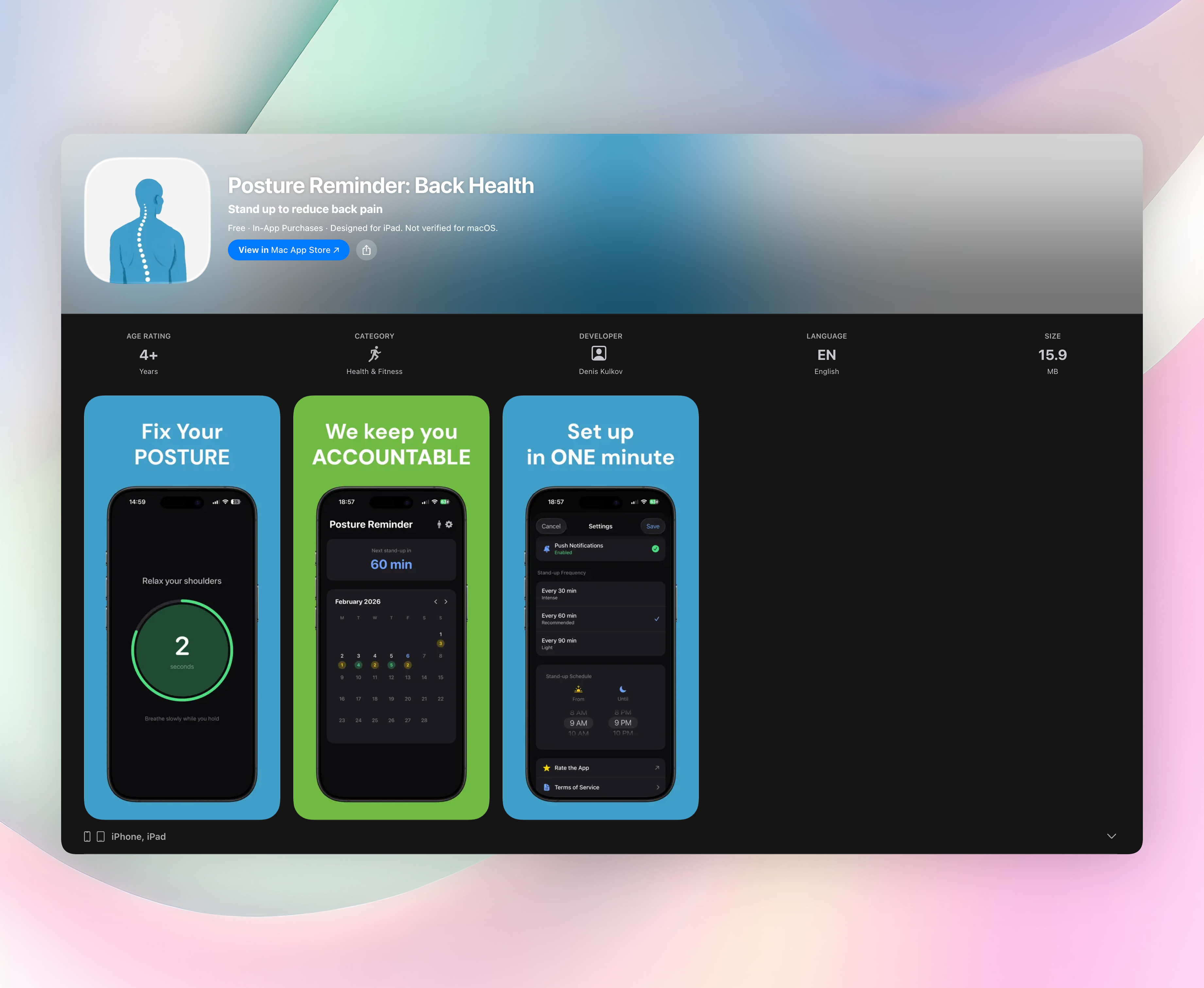
The failure point is never the routine, it's remembering at 11:15. Something has to ask at set intervals: a recurring calendar block does the job, and so does Posture Reminder, a posture reminder app for iPhone and Apple Watch.
What office stretches won't fix
Stretching changes length. It doesn't build the endurance the deep neck flexors, mid and lower traps, and glutes need to hold a position for hours, so pair it with strength work.
A workstation that forces a shape beats two minutes of stretching every time. Monitor top near eye level, screen about an arm's length away, elbows near 90 degrees, feet supported: an ergonomic desk setup does more than any routine.
These are general ergonomics stretches, not treatment. Numbness, tingling, arm weakness, or neck or back pain past a couple of weeks is a reason to see a physician or physical therapist.
FAQ
How often should I do posture stretches?
Two or three passes across the workday, on days you sit a lot. Repeated interruption does more than one long session, and a single mid-afternoon pass beats none.
How long should I hold each stretch?
Ten to 30 seconds is the standard hold for adults, repeated two to four times, landing near a minute per muscle across the day.
Can stretches for posture fix rounded shoulders or forward head posture?
They remove one limitation, length. They don't supply strength or habit, and they don't change a desk that puts you back in the same shape.
Should posture stretches hurt?
No. A 3 or 4 out of 10 pull that eases as you hold is the target. Sharp, burning, or radiating sensations mean stop.
Free Posture Reminder tools
- Anterior Pelvic Tilt TestThis anterior pelvic tilt test turns standing side-view observations into a simple posture score and neutral-position cues. It is a non-diagnostic screen, not a clinical assessment.
- Desk Chair Height CalculatorEstimate a desk chair height range from your height and desk height, then check whether your current chair supports a workable seated posture.
- Forward Head Posture CheckerUse a side-profile photo to estimate your craniovertebral angle with two clicks. This posture checker is a rough self-check, not a diagnosis.
- Monitor Height Ergonomics CalculatorEnter your seated eye height, monitor height, screen height and viewing distance to compare your setup with monitor height ergonomics targets.
- Posture Assessment ScoreAnswer a few desk posture questions, add your seated minutes and breaks, and get a non-diagnostic score with the highest-impact setup habits to review.
- Proper Sitting Posture at Desk CheckerCompare your desk, chair and monitor dimensions with height-scaled targets for a practical 90-90-90 sitting setup.
- Standing Desk Converter PlannerPlan a conversion standing desk setup from your body height, current desk, monitors and laptop. Get the converter lift, minimum surface width and estimated load.
- Standing Desk Height CalculatorEstimate a comfortable starting height for your standing desk, monitor, chair and screen viewing distance. Enter your body height and shoe heel height in centimetres or inches.
- Standing Desk TimerSet a sit/stand pattern and work-block length, then follow a live countdown with the next switch time, full schedule and sitting and standing totals.
- Wall Test Posture CheckUse a wall test for posture to record four contact findings and two gap measurements. Get a rough posture score, plain-language suggestions and the finding to address first.
- Workspace Ergonomics CalculatorUse an ergonomics calculator to set a desk or keyboard height, seat height, monitor top and viewing distance for seated or standing work.