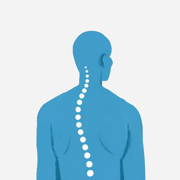
Winged scapula: why the blade lifts and what strengthens it
A winged scapula is a shoulder blade whose medial border lifts away from the ribcage instead of lying flat against it. Most desk-related cases trace back to a serratus anterior that isn't holding the blade down. A smaller share comes from nerve injury and needs a clinician.
What the serratus anterior actually does
The serratus anterior fans from the upper eight or nine ribs to the front of the scapula's medial border. That wrap gives it two jobs: press the blade flat against the ribcage, and rotate it upward as the arm travels overhead, working with the upper and lower trapezius. When it can't hold tension under load, the medial border or the inferior angle peels off the ribs.
This isn't the same fault as rounded shoulders, which describes where the blade rests; winging is whether it stays glued during effort. The usual cue for the first — squeeze the blades together — trains retraction, the opposite of what the serratus does, so rounded shoulders is a separate conversation.
Postural winging vs. nerve-related scapular winging
Two different problems produce a blade that lifts, and the pattern usually separates them.
| Sign | Postural, weakness-driven | Nerve-related |
|---|---|---|
| Onset | Gradual, noticed in a photo | Over days or a few weeks |
| Pain | Usually none | Often severe shoulder or neck pain that fades and leaves weakness |
| Arm at rest | Blade sits close to flat | Wing can be obvious with the arm hanging |
| Under load | Lifts during push-ups, planks, front raises | Lifts early, at low effort |
| Overhead reach | Full, maybe effortful | Often limited near or above shoulder height |
| Sides | Both, or mildly uneven | Usually one |
Medial winging — the inferior angle drifting toward the spine — points at the serratus anterior and its nerve, the long thoracic (C5–C7). Lateral winging, with the inferior angle swinging away from the spine, points at the trapezius and the spinal accessory nerve, which is why it turns up after neck or lymph-node surgery. Rhomboid winging, via the dorsal scapular nerve, is rarer and subtler.
Book an appointment rather than a training block if the wing appears suddenly, follows shoulder pain or surgery near the armpit or neck, or comes with an arm you can't raise past shoulder height. Those point at causes an exercise article can't rule in or out.
Common winged scapula causes
- End-range protraction never gets loaded. Most gym programs stop at "arms straight." The last stretch of range, where the blade wraps around the ribs, is the part the serratus owns.
- A pull-heavy program. Rows, face pulls, and band pull-aparts train holding the blade back, not holding it down.
- A short pectoralis minor. Running from the coracoid process to ribs three through five, it tilts the blade forward and lifts the inferior angle — a common companion to upper crossed syndrome.
- A stiff thoracic spine. A blade rotates upward only as far as the ribcage underneath it allows.
- Nerve injury. Traction from heavy pack straps, a blow to the lateral chest wall, or surgery near the armpit.
Check it against a wall
Stand a step back from a wall, hands at chest height and slightly wider than your shoulders. Lower your chest over three slow counts, press back out, and at the top keep pushing until the upper back rounds and the blades wrap forward. Do ten — fatigue is what exposes a wing, so rep ten tells you more than rep one.
Film it from behind or watch in an angled mirror, looking for a medial border that lifts on the way down, one side lifting more than the other, or a top position you can't reach.
Winged scapula exercises that load the serratus
These three cover the muscle's whole job: pinning the blade, rotating it up, holding it under load. Two or three sessions a week is plenty, and serratus anterior exercises reward slow tempo far more than added weight.
The push-up plus exercise
Do a push-up from the floor, your knees, or a counter. At the top, once the elbows are locked, keep pressing until the blades slide around the ribcage and the upper back rounds a little. Hold two seconds, then lower under control — two or three sets of eight to twelve. Shrugging toward the ears or poking the chin forward means the traps have taken the job.
Wall slides with protraction
Forearms on the wall about shoulder-width apart, elbows near chest height, thumbs toward you. Press the forearms in, slide up until you feel the blades rotating upward, then reach at the top — push the wall away without shrugging. Keep the lower ribs down; letting them flare turns this into a back extension. Two or three sets of eight to ten, with a two-second reach at the top.
Overhead carries
Press a single dumbbell or kettlebell overhead, elbow locked, upper arm near the ear, ribs stacked over the pelvis. Walk twenty to thirty seconds, then switch sides. The blade has to stay upwardly rotated the whole walk — serratus and lower trapezius work you can't cheat. Start lighter than feels impressive — a weight you can hold in a clean overhead position beats one that flares your ribs.
How fast a blade sits flatter depends on the cause: weakness-driven cases usually feel different within weeks, while nerve-related cases follow the nerve's timeline.
The eight hours between sessions
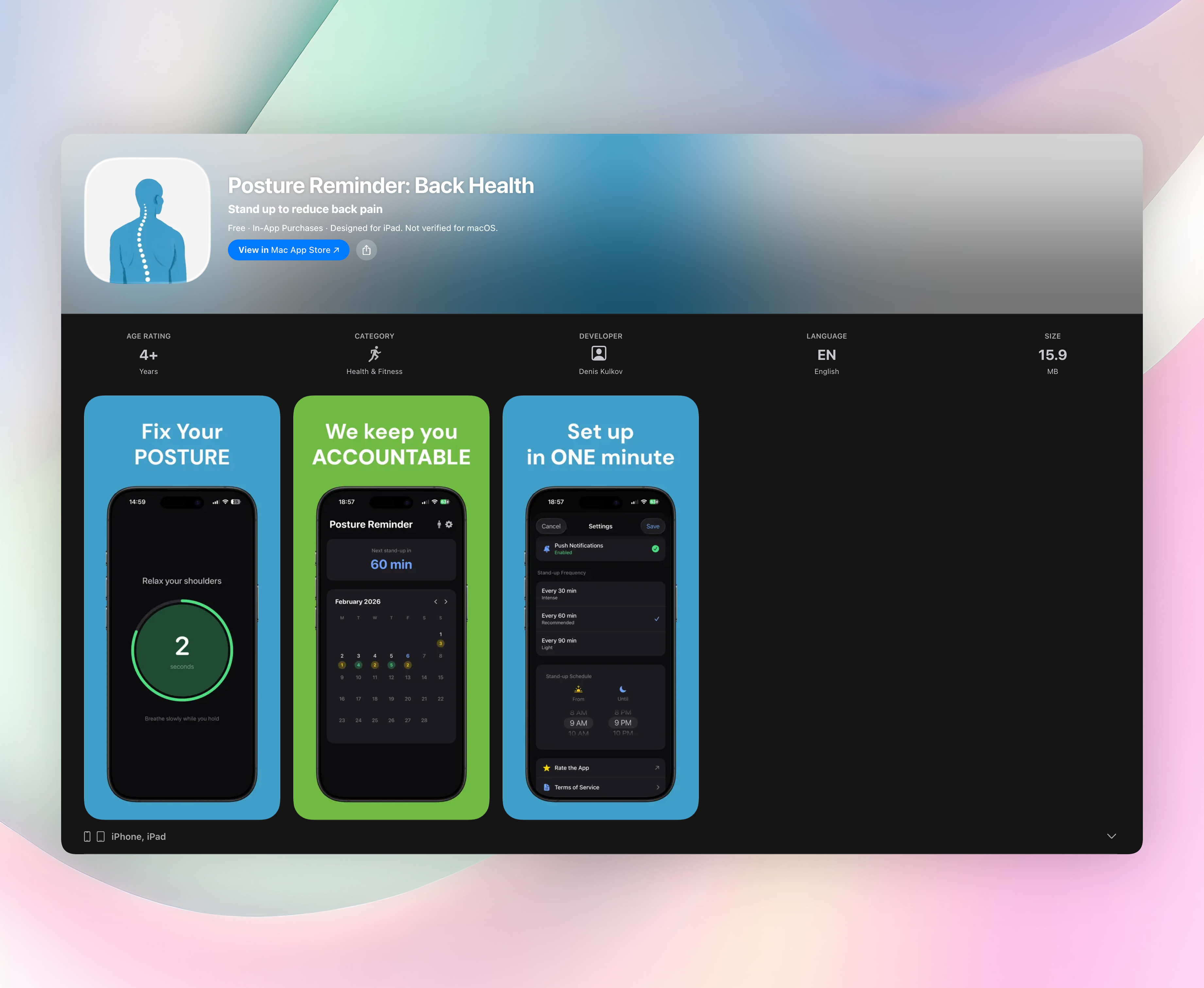
Ten minutes of serratus work sits inside a day spent mostly reaching forward. Set the chair and monitor so your elbows stay near your sides, then reset periodically instead of holding one posture — a blade set at 9 a.m. is not still set at 3 p.m. Posture Reminder, a posture reminder app for iPhone and Apple Watch, can prompt those resets through the workday.
FAQ
What causes a winged scapula?
At a desk, the usual driver is a serratus anterior that never trains end-range protraction, often alongside a short pec minor and a stiff upper back. A smaller group stems from injury to the long thoracic, spinal accessory, or dorsal scapular nerve. Sudden onset, one side only, pain, or limited overhead reach points toward the nerve side.
Is scapular winging serious?
On its own, a blade that lifts under load is a mechanical finding, not an emergency. Why it lifts is what matters. Sudden onset, severe pain before the weakness, or an arm you can't lift past shoulder height should be assessed rather than trained around.
Can you correct a winged scapula at home?
Weakness-driven winging responds to loading the serratus, and the exercises above need nothing beyond a wall and a light weight. The nerve-related version belongs with a professional who can test it. If any of it produces pain, stop and get it looked at.
Do push-ups make winging worse?
A standard push-up stops at elbow lockout, which leaves the serratus's best range untrained, and grinding out reps you can't control mostly rehearses the wing. Adding the plus at the top turns it from a chest exercise into a scapular one.
Does a posture brace help a winged scapula?
A brace pulls the shoulders back, and retraction is a different action from the protraction the serratus performs, so it doesn't address a blade lifting off the ribs. Some find it a useful cue, but posture correctors have limits worth understanding first.
Free Posture Reminder tools
- Anterior Pelvic Tilt TestThis anterior pelvic tilt test turns standing side-view observations into a simple posture score and neutral-position cues. It is a non-diagnostic screen, not a clinical assessment.
- Desk Chair Height CalculatorEstimate a desk chair height range from your height and desk height, then check whether your current chair supports a workable seated posture.
- Forward Head Posture CheckerUse a side-profile photo to estimate your craniovertebral angle with two clicks. This posture checker is a rough self-check, not a diagnosis.
- Monitor Height Ergonomics CalculatorEnter your seated eye height, monitor height, screen height and viewing distance to compare your setup with monitor height ergonomics targets.
- Posture Assessment ScoreAnswer a few desk posture questions, add your seated minutes and breaks, and get a non-diagnostic score with the highest-impact setup habits to review.
- Proper Sitting Posture at Desk CheckerCompare your desk, chair and monitor dimensions with height-scaled targets for a practical 90-90-90 sitting setup.
- Standing Desk Converter PlannerPlan a conversion standing desk setup from your body height, current desk, monitors and laptop. Get the converter lift, minimum surface width and estimated load.
- Standing Desk Height CalculatorEstimate a comfortable starting height for your standing desk, monitor, chair and screen viewing distance. Enter your body height and shoe heel height in centimetres or inches.
- Standing Desk TimerSet a sit/stand pattern and work-block length, then follow a live countdown with the next switch time, full schedule and sitting and standing totals.
- Wall Test Posture CheckUse a wall test for posture to record four contact findings and two gap measurements. Get a rough posture score, plain-language suggestions and the finding to address first.
- Workspace Ergonomics CalculatorUse an ergonomics calculator to set a desk or keyboard height, seat height, monitor top and viewing distance for seated or standing work.