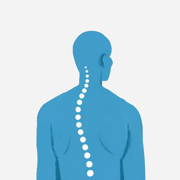
Neck hump: the three kinds, and the one you can actually fix
A neck hump isn't one condition. The bump at the base of your neck is either postural rounding at the cervicothoracic junction, a soft fat pad, or a structural change in the thoracic vertebrae. Only the first reliably responds to exercise.
The three things people call a neck hump
Run a finger down the back of your neck and you'll hit a bony point where neck meets upper back: the C7 spinous process, palpable on nearly everyone. It's a landmark, not a defect. What varies is what sits around it.
Postural rounding. The upper thoracic spine settles into flexion, the head translates forward to keep the eyes level, and the C7–T1 area becomes the apex of the curve. Soft tissue bunches over that apex. The bones haven't changed shape; their position has.
A dorsocervical fat pad. A soft, movable mound over the same region, often called a buffalo hump. Fat can collect there with general weight gain, but a pad that appears quickly without matching weight change deserves a doctor's attention — several hormonal conditions and some long-term medications are associated with fat redistribution in that area.
Structural kyphosis. The vertebrae themselves are wedged or have lost height. Scheuermann's kyphosis, which develops in adolescence and involves wedge-shaped thoracic vertebrae, belongs here, as does age-related hyperkyphosis following vertebral compression fractures. A typical thoracic curve measures roughly 20 to 45 degrees on X-ray, though the number shifts with which vertebrae are included. A rigid curve well past that range is structural.
The three overlap often — rounding stacked on a structural curve is common. How to get rid of a neck hump depends entirely on which one dominates, so sort that first.
The self-check that tells them apart
Before asking how to fix a neck hump, test one thing: whether the curve is flexible.
Floor test. Lie face up on a hard floor, knees bent, no pillow. Let gravity pull your upper back down for 60 seconds, then notice where the back of your head sits. If it settles closer to the floor than your standing posture suggests, and the mound softens, the curve moves.
Foam roller test. Place a foam roller across your upper back at the apex, support your head in your hands so the neck isn't hinging, keep the ribs down, and drape backward over it for 30 seconds. Then check a side-view photo. Postural rounding flattens visibly and the shoulders settle back. A structural curve stops at a hard end-point that feels like bone, not stretch. A fat pad looks the same either way — the tissue over the spine doesn't care what the spine is doing.
| Postural rounding | Dorsocervical fat pad | Structural kyphosis | |
|---|---|---|---|
| Feels like | firm bony ridge, normal tissue | soft, doughy, movable | hard, fixed prominence |
| Changes over a roller | flattens visibly | unchanged | hard end-feel |
| Typical onset | gradual, tracks desk habits | can build over months | adolescence, or after bone loss |
| Exercise changes it | yes | no | helps the rounding on top, not the curve |
| Sensible first step | thoracic extension work | see a doctor | clinical assessment |
This is triage, not diagnosis. Anything painful, numb, or rapidly changing goes to a clinician first.
Why postural rounding builds at the cervicothoracic junction
An adult head weighs roughly 10 to 12 pounds, and the further forward it sits, the more leverage it applies to the tissues holding it up. Hold that for hours and the pattern sets: the deep neck flexors stop contributing, the upper traps and levator scapulae take over, the pecs shorten. That's the upper crossed syndrome pattern, and the cervicothoracic junction is where its two halves meet.
Screens accelerate it by pulling the head down and forward at once. Sustained flexion is the driver, not any single posture — two minutes of rounding means nothing, six hours of it most days is the input that produces hunchback posture.
Neck hump exercises that target the thoracic spine
The goal is extension range in the upper back plus the endurance to hold it. Mobility alone gives you a curve that flattens on a roller and returns by lunchtime, so the kyphosis exercises worth doing pair the two.
Foam roller thoracic extension. Roller across the upper back, hands behind the head, hips down. Extend over it until you feel a stretch, hold two breaths, shift the roller up an inch, repeat. Cover three or four positions between the shoulder blades. Stop below the ribcage — the lumbar spine isn't the target.
Chin tucks. Draw the head straight back over the shoulders without tilting it down, hold 5 seconds, release. Ten reps. It trains the deep neck flexors that switch off under load — the least impressive drill here, and the one that changes forward head posture most directly.
Wall angels. Back against a wall, arms in a goalpost, slide up and down keeping wrists and the back of the head in contact. If the head won't touch without your chin lifting, stand an inch or two off the wall and work in. Eight to ten slow reps.
Prone Y raise. Face down, arms overhead in a Y, lift arms and chest a few inches using the mid-back rather than the lower back. Hold 3 seconds, 10 reps. This builds the lower trapezius endurance that holds the extension you just earned.
Two to three minutes most days beats twenty minutes on Sunday. Frequency does the work here.
What the timeline actually looks like
Range of motion changes first. Over the first two weeks the roller position gets more comfortable and you reach further into extension. Endurance follows over roughly four to six weeks, when holding upright stops feeling like effort. Visible change in side-view photos usually lands in the 8-to-12-week window, and only if the daily work stayed daily.
That last clause is where most attempts fail. The protocol isn't hard, just short and easy to skip on a busy day — and a two-minute drill missed four days a week is a different program. A scheduled cue solves more of this than better exercise selection does. Posture Reminder is a posture reminder app for iPhone and Apple Watch.

Ergonomics carries the other half. Two minutes of extension against eight hours of flexion is a losing ratio, so an ergonomic desk setup — monitor at eye level, phone up off your lap — matters as much as the drills.
When exercise isn't the answer
A fat pad won't respond to thoracic mobility work, and a fixed structural curve won't reverse with it — though extension and mid-back strength are still worth doing around one, since the rounding stacked on top is usually the visible part. Neck or arm pain, numbness, tingling, known osteoporosis, or a hump that appeared over a few months all warrant a physician or physical therapist rather than self-treatment.
FAQ
How do you get rid of a neck hump?
If it's postural, daily thoracic extension plus deep neck flexor and mid-back strength work over 8 to 12 weeks is the usual approach, paired with fixing whatever position you hold for hours a day. If it's a fat pad or a structural curve, exercise won't remove it — which is why the roller self-check comes first.
How long does it take to fix hunchback posture?
Mobility improves within a couple of weeks, endurance over four to six, and visible change usually needs 8 to 12 weeks of near-daily work. Results plateau quickly if the desk and phone habits behind it don't change.
Is a neck hump the same as a dowager's hump?
They get used interchangeably, but "dowager's hump" traditionally described age-related hyperkyphosis linked to bone loss and vertebral compression fractures. That version is structural. A younger person's neck hump is far more often postural — a different problem with a different answer.
Can you fix a neck hump after 60?
Postural rounding responds to training at any age — thoracic mobility and mid-back strength both improve in older adults. What changes is that structural contributors get more likely, so a new or worsening hump is worth raising with a doctor before assuming exercise is the fix.
Free Posture Reminder tools
- Anterior Pelvic Tilt TestThis anterior pelvic tilt test turns standing side-view observations into a simple posture score and neutral-position cues. It is a non-diagnostic screen, not a clinical assessment.
- Desk Chair Height CalculatorEstimate a desk chair height range from your height and desk height, then check whether your current chair supports a workable seated posture.
- Forward Head Posture CheckerUse a side-profile photo to estimate your craniovertebral angle with two clicks. This posture checker is a rough self-check, not a diagnosis.
- Monitor Height Ergonomics CalculatorEnter your seated eye height, monitor height, screen height and viewing distance to compare your setup with monitor height ergonomics targets.
- Posture Assessment ScoreAnswer a few desk posture questions, add your seated minutes and breaks, and get a non-diagnostic score with the highest-impact setup habits to review.
- Proper Sitting Posture at Desk CheckerCompare your desk, chair and monitor dimensions with height-scaled targets for a practical 90-90-90 sitting setup.
- Standing Desk Converter PlannerPlan a conversion standing desk setup from your body height, current desk, monitors and laptop. Get the converter lift, minimum surface width and estimated load.
- Standing Desk Height CalculatorEstimate a comfortable starting height for your standing desk, monitor, chair and screen viewing distance. Enter your body height and shoe heel height in centimetres or inches.
- Standing Desk TimerSet a sit/stand pattern and work-block length, then follow a live countdown with the next switch time, full schedule and sitting and standing totals.
- Wall Test Posture CheckUse a wall test for posture to record four contact findings and two gap measurements. Get a rough posture score, plain-language suggestions and the finding to address first.
- Workspace Ergonomics CalculatorUse an ergonomics calculator to set a desk or keyboard height, seat height, monitor top and viewing distance for seated or standing work.