Slouching at a desk: why it happens and how to stop it
Slouching isn't a strength problem. It's an endurance and habit problem. Slumping hands the load to your ligaments and discs so the back muscles can switch off, which makes it the cheapest position available, and untrained postural muscles run out of energy for the alternative within minutes.
Why slouching is cheaper than sitting up
Slump forward and your trunk rotates until the spine's passive structures (posterior ligaments, thoracolumbar fascia, the outer rings of the discs) run out of slack and start carrying you. EMG work on trunk flexion calls this the flexion-relaxation phenomenon: past a certain angle, the erector spinae go nearly quiet. The chair takes some of the load, connective tissue takes the rest, and the muscles idle.
That's most of the answer to why you slouch. Your nervous system is an efficiency engine, and given two ways to hold a position for forty minutes it picks the one that burns less. Nobody has to learn to slouch. You learn out of it, and the learning evaporates the second attention goes elsewhere.
The cost isn't dramatic in any single hour. It's low-grade load on tissues that are slow to complain and slow to recover, with no variation to break it up: same segments, same angles, same six hours. That's why ergonomics has largely stopped chasing one correct posture and started targeting posture variation. A neutral spine is a range you move through, not a shape you clamp into.
Why sitting up straight hurts
If sitting up straight hurts within a few minutes, that's usually deconditioning rather than damage. The deep spinal muscles, multifidus and the segmental paraspinals, are predominantly slow-twitch tissue built for hours of low-level work. Leave them idle for a few years and they behave like any untrained muscle: a burn between the shoulder blades, then a slow slide back down.
There's a second reason, and it's self-inflicted. "Sit up straight" usually gets performed as a military brace, with the chest lifted, ribs flared, lumbar spine cranked into end-range extension and shoulders pinned back. That isn't neutral, it's the opposite extreme. End-range extension shifts load onto the facet joints and costs more effort than a moderate upright position, so it collapses fast and confirms the belief that good posture is unbearable.
Ordinary postural fatigue fades within a minute or two of changing position. Pain that's sharp, one-sided, radiates into an arm or leg, or shows up away from the desk is worth taking to a physical therapist or physician. This is general ergonomics guidance, not a substitute for an assessment.
Postural endurance fails long before the workday does
Watch anyone at a desk and the slump appears in the first ten to twenty minutes of a work block, then deepens. Low-threshold motor units get recruited first and released last, so the same small fibers carry a static hold from the first minute to the last. Occupational EMG researchers call this the Cinderella hypothesis, and it explains why easy-looking static postures fatigue out of proportion to the effort involved.
The consequence is practical: you can't solve a duration problem with intensity. Heavy lifting won't extend how long you can sit upright, because the limiting quality is endurance measured in minutes. Clinicians test it with timed holds — the Biering-Sørensen back extension test is scored in seconds, not pounds — and it improves the way endurance always improves, through short and frequent exposure.
How to stop slouching at a desk
Treat it as graded exposure. All-day vigilance is the method that fails by Wednesday.
- Find your honest baseline. Sit upright until the first real burn and note the time. Three minutes is a normal starting point. Use the number you got, not the one you wanted.
- Work in intervals. Hold upright for your baseline, then take a deliberate rest against the backrest, reclined slightly. An angle in the neighborhood of 100 to 110 degrees with good lumbar contact loads the spine less than perching bolt upright at 90. The rest is part of the protocol, not a failure of it.
- Add about a minute a week to the upright interval. Progression this slow feels pointless in week one and obvious in week six.
- Rotate positions instead of holding one. A widely used office rotation is roughly twenty minutes seated, eight standing, two moving. The exact split matters less than the guarantee that something changes every half hour.
- Give the muscles a reason to adapt off the chair. Short holds such as side planks and wall slides build the endurance the chair keeps asking for. More on the full picture in how to fix bad posture.
Set the desk so upright is the cheap option
Behavior change gets easier when the environment stops fighting it. Monitor top near eye level and about an arm's length away, elbows near your sides with forearms roughly level, feet flat or on a footrest, hips level with or slightly above the knees, low back in contact with the backrest. A laptop flat on the desk guarantees a flexed neck; a stand and an external keyboard removes the argument. The full ergonomic desk setup is worth one afternoon.
How to remember to sit up straight
The hard part isn't knowing the position. It's noticing you've left it. Slouching runs as a background process, so catching it needs an interrupt from outside your own attention.
| Cue | Why it can work | Why it usually stops working |
|---|---|---|
| Sticky note on the monitor | Sits in your line of sight | Goes invisible within days; the brain filters static objects |
| Willpower and self-monitoring | Free, always available | Competes with the work you're paid to concentrate on |
| Posture brace or shirt | Immediate physical feedback | Does the holding for you, and stops when it comes off |
| Mirror or webcam self-view | Honest picture of what you look like | You only check when you already suspect you're slouching |
| Habit stacking (check at a fixed trigger) | Rides an existing habit | Only fires as often as the trigger does |
| Scheduled reminder | Fires on a clock, independent of attention | Dismissed reflexively if the interval is too tight |
Only the last row reliably fires before the slouch has become the default position, which is the whole point. A nudge at minute 18 costs you nothing; a nudge at minute 90 arrives after the load has sat on the same tissues for an hour. Posture Reminder is a posture reminder app for iPhone and Apple Watch, built around exactly that idea: a schedule that nudges you before the slouch sets in, instead of a note you stop seeing or a habit you have to police yourself.
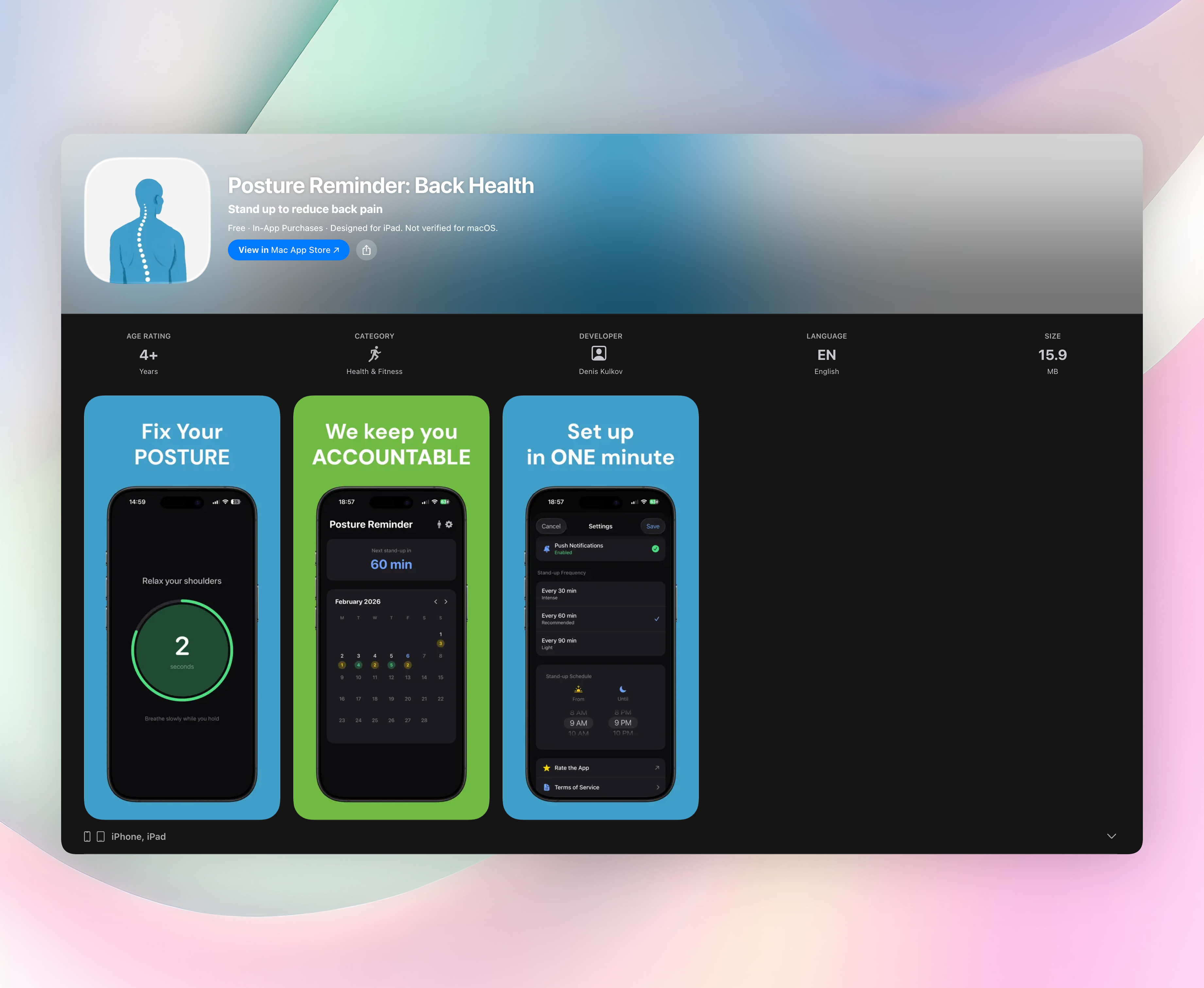
Match the interval to the baseline you measured, not the one you wish you had. A prompt that interrupts an upright stretch you're still comfortably holding just trains you to swipe it away.
FAQ
Is slouching actually bad for you?
A few minutes of slouching is unremarkable, and the spine tolerates flexion perfectly well. The problem is duration and sameness: hours in one loaded position with nothing breaking it up. Alternating between upright, reclined and standing matters more than never slumping.
Why does sitting up straight hurt more than slouching?
Because upright costs muscular effort and slouching doesn't. Deconditioned postural muscles fatigue in minutes, and most people overcorrect into an exaggerated arch that's harder to hold than true neutral. If sitting up straight hurts sharply rather than burning dully, have it looked at.
How long does it take to stop slouching?
The endurance side improves over weeks, and the burn usually arrives noticeably later after a month of consistent intervals. The habit side takes longer, because it depends on how reliably something reminds you. For most people the cue is the slower half.
Do posture correctors work?
They work as a sensation cue, since you feel where your shoulders drift. They don't build endurance, because the device performs the work your muscles need to be doing. Treat one as training wheels with an end date.
Does a standing desk stop slouching?
It helps mainly by making position changes easy, not because standing is inherently correct. People slouch standing too, usually into a hip-forward lean with the weight on one leg. Use it as one position in a rotation, not a replacement chair.
Free Posture Reminder tools
- Anterior Pelvic Tilt TestThis anterior pelvic tilt test turns standing side-view observations into a simple posture score and neutral-position cues. It is a non-diagnostic screen, not a clinical assessment.
- Desk Chair Height CalculatorEstimate a desk chair height range from your height and desk height, then check whether your current chair supports a workable seated posture.
- Forward Head Posture CheckerUse a side-profile photo to estimate your craniovertebral angle with two clicks. This posture checker is a rough self-check, not a diagnosis.
- Monitor Height Ergonomics CalculatorEnter your seated eye height, monitor height, screen height and viewing distance to compare your setup with monitor height ergonomics targets.
- Posture Assessment ScoreAnswer a few desk posture questions, add your seated minutes and breaks, and get a non-diagnostic score with the highest-impact setup habits to review.
- Proper Sitting Posture at Desk CheckerCompare your desk, chair and monitor dimensions with height-scaled targets for a practical 90-90-90 sitting setup.
- Standing Desk Converter PlannerPlan a conversion standing desk setup from your body height, current desk, monitors and laptop. Get the converter lift, minimum surface width and estimated load.
- Standing Desk Height CalculatorEstimate a comfortable starting height for your standing desk, monitor, chair and screen viewing distance. Enter your body height and shoe heel height in centimetres or inches.
- Standing Desk TimerSet a sit/stand pattern and work-block length, then follow a live countdown with the next switch time, full schedule and sitting and standing totals.
- Wall Test Posture CheckUse a wall test for posture to record four contact findings and two gap measurements. Get a rough posture score, plain-language suggestions and the finding to address first.
- Workspace Ergonomics CalculatorUse an ergonomics calculator to set a desk or keyboard height, seat height, monitor top and viewing distance for seated or standing work.