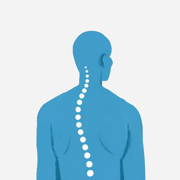
Tech neck: the load math, the symptoms, and the fix order
Tech neck is neck pain, stiffness, and shoulder tension that builds up from holding your head tilted forward to look at a phone, tablet, or laptop. The further your chin drops, the harder the muscles at the back of your neck work to hold the head up. It's a load problem, not a disease.
What is tech neck?
"Tech neck" isn't a formal diagnosis. No clinician codes it. It's shorthand for a cluster of complaints common to people who spend hours a day in cervical flexion, sometimes called text neck or forward-head-posture neck pain. The informal label doesn't make the mechanics fake: what's measurable is how hard your neck extensors work to hold a forward head against gravity, and how long they do it without a break.
One caveat the internet usually skips: the research linking posture to neck pain is messier than the headlines suggest. Plenty of people with textbook forward head posture have no symptoms, and plenty with tidy alignment hurt anyway. Posture is a useful lever because it's the easiest one to change, not because it's the only one that matters.
The load math: why looking down multiplies head weight
An adult head weighs roughly 10 to 12 pounds. Balanced over the spine, that's all your neck supports. Tilt it forward and the head's center of mass moves out in front of the supporting column, turning simple weight into torque. The extensors now counteract a lever arm, and the effective load climbs fast.
The numbers everyone quotes come from a 2014 biomechanical model by spine surgeon Kenneth Hansraj, which calculated the force on the cervical spine at a series of flexion angles:
| Head tilt | Calculated load on the cervical spine | Roughly what it feels like |
|---|---|---|
| 0° (neutral) | 10–12 lb | A bowling ball |
| 15° | ~27 lb | A car tire |
| 30° | ~40 lb | A loaded carry-on |
| 45° | ~49 lb | A five-gallon water jug |
| 60° | ~60 lb | An eight-year-old |
Keep it honest, though: that's a static computer model, not force measured inside a living neck, and it simplifies head and neck into a single lever, ignoring muscle co-contraction and how the joints share load. Studies measuring actual muscle activity find the same direction of effect with smaller multiples. Treat the table as a ranking of positions, not a readout of pounds.
The ranking is the useful part. Sixty degrees is roughly a phone in your lap, near the end of comfortable cervical flexion. Chest height lands around 30 to 45. Eye level is close to zero. Buying back even 15 degrees moves you a full row up that table, and it costs nothing but a raised forearm.
The hours add up faster than the angle
Peak angle gets the attention, but duration does the damage. A 45-second glance at 45 degrees is nothing. Forty-five minutes at 45 degrees is what makes your neck ache by evening, because sustained low-level muscle work fatigues tissue in a way brief spikes don't.
Do the multiplication on your own screen-time number. Two hours a day of head-down phone time is 730 hours a year, about 30 full days. Three hours a day is over 1,000. That's before laptop work, and laptops are worse by design: screen and keyboard are bolted together, so putting one at the right height guarantees the other is wrong.
Tech neck symptoms, and the ones people misattribute
The typical picture:
- Aching or burning across the base of the neck and between the shoulder blades
- Stiffness and reduced rotation, usually worse late in the day
- Tightness through the upper traps and levator scapulae
- Headaches starting at the base of the skull and wrapping forward, the pattern clinicians call cervicogenic
- Sometimes jaw tension
The giveaway is the pattern. Postural neck symptoms load up through the day, ease overnight, and respond to changing position. Pain that's worst on waking or doesn't shift when you move is telling you something else. Tingling, numbness, or weakness running down an arm or into the hand isn't part of the ordinary picture either — that suggests nerve root irritation and belongs with a clinician, not a stretching routine.
The muscle-balance version of this pattern, tight chest and upper traps paired with weak deep neck flexors and lower traps, has its own name: upper crossed syndrome.
The neck lines are a different problem entirely
Skincare marketing borrowed the same term for the horizontal creases across the front of the throat, which causes constant confusion. Those are a skin issue driven by sun exposure, collagen change, repeated folding, and genetics. Infants have them, as do people who've never held a smartphone. Fixing screen height won't erase a crease, and no serum will stop your neck aching after four hours in flexion.
How to fix tech neck: three moves, in order of impact
Most people run this backwards, starting with exercises while keeping the phone in their lap, which is like adding reps and weight at once. Take load off first, cut exposure second, build tolerance third.
1. Raise the device
Biggest return, least effort.
- Bring the phone toward eye level and brace the elbow against your ribs, so your shoulder isn't holding the weight.
- Put the laptop on a stand with an external keyboard. It's the only way to fix both halves at once.
- Set the monitor top at or just below eye level, about an arm's length away.
- Reading in bed is the worst offender: prop the arm on a pillow rather than resting the phone on your stomach.
More on the full workstation in the guide to an ergonomic desk setup.
2. Shorten the sessions
Duration is the second lever, and it's harder because the drift is invisible. You start with the phone at eye level, and ten minutes later it's in your lap with your chin on your chest. Deciding to "be more aware of my posture" fails for exactly that reason: what you're trying to catch is the slow slide out of awareness.
Which is the argument for an external prompt rather than willpower. Posture Reminder is a posture reminder app for iPhone and Apple Watch, and the mechanism that matters is simple: a nudge on a set interval interrupts the drift and gives you a moment to lift the phone back to eye level.
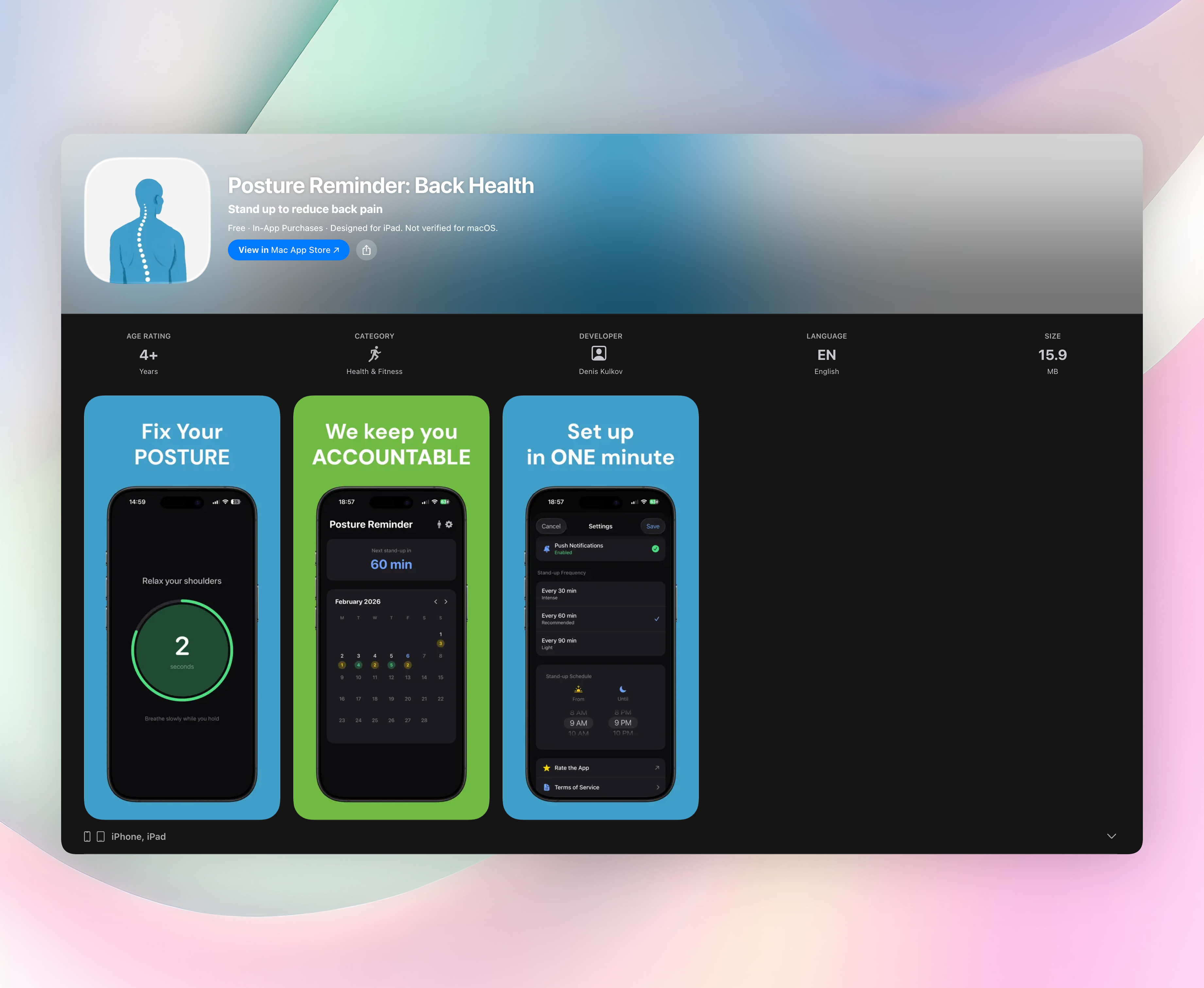
Whatever prompts you, the response is the same: reset to a neutral spine, let the shoulders drop back, raise the device. Changing position often beats holding one good position perfectly.
3. Drill chin tucks
Tech neck exercises target the deep neck flexors, the longus colli and capitis, endurance muscles whose job is holding the head stacked over the shoulders. They fatigue when the upper traps take over.
Chin tuck. Sit or stand tall, eyes level. Glide your head straight back over your shoulders, making a double chin. It's a glide, not a nod, so don't drop your gaze. Hold 5 seconds, release. Ten reps, two or three times a day. It should feel like a stretch at the base of the skull, not a strain.
Worth adding once that's easy:
- Thoracic extension over a chair back or foam roller. A stiff mid-back forces the neck to produce extension it can't.
- Doorway pec stretch, 30 seconds a side. The front shortens as the back lengthens.
- Scapular retraction or wall slides, to give the upper back something to hold with.
Exercises build tolerance. They don't cancel the load. Chin tucks in the morning followed by six hours at 45 degrees still runs a deficit, which is why this step is third rather than first. Give it four to six weeks of consistency before judging it.
When to stop self-managing
This is general ergonomics guidance, not medical advice. See a physical therapist, physician, or other qualified clinician if pain doesn't change when you change position, if there's numbness, tingling, or weakness in an arm or hand, if headaches are new or severe, if there's dizziness or visual change, or if a few weeks of honest setup changes haven't moved anything. Necks hurt for plenty of reasons other than phones, and the ones worth investigating are those that don't respond to unloading.
FAQ
How long does it take to get rid of tech neck?
If it's straightforward postural ache, setup changes register within days, since the load comes off the moment the screen goes up. Building deep neck flexor endurance is slower: four to six weeks of consistent work is realistic. Symptoms that haven't budged after a few weeks of genuine changes should be assessed rather than waited out.
Is tech neck permanent?
The soft-tissue side isn't. Overworked, shortened muscles adapt back once the load changes. What tends to persist is the habit of dropping into flexion without noticing, which is why the environment matters more than motivation.
Can tech neck cause headaches?
It can contribute. Sustained tension through the suboccipital muscles and upper traps is a recognized source of headache that starts at the base of the skull and refers forward, sometimes behind the eye. Headaches that are new, severe, or unlike your usual pattern need a clinical opinion.
How do you prevent tech neck with a desk job?
Set screen height once so neutral is the default rather than something you maintain, then break up long sitting blocks. Positioning that holds for eight hours a day beats exercises you do for five minutes.
Do posture correctors help?
Braces cue the shoulder blades back, and some people find that a useful short-term reminder. They don't build endurance, and the driver here is usually screen height, not shoulder position. Fix the desk first.
Free Posture Reminder tools
- Anterior Pelvic Tilt TestThis anterior pelvic tilt test turns standing side-view observations into a simple posture score and neutral-position cues. It is a non-diagnostic screen, not a clinical assessment.
- Desk Chair Height CalculatorEstimate a desk chair height range from your height and desk height, then check whether your current chair supports a workable seated posture.
- Forward Head Posture CheckerUse a side-profile photo to estimate your craniovertebral angle with two clicks. This posture checker is a rough self-check, not a diagnosis.
- Monitor Height Ergonomics CalculatorEnter your seated eye height, monitor height, screen height and viewing distance to compare your setup with monitor height ergonomics targets.
- Posture Assessment ScoreAnswer a few desk posture questions, add your seated minutes and breaks, and get a non-diagnostic score with the highest-impact setup habits to review.
- Proper Sitting Posture at Desk CheckerCompare your desk, chair and monitor dimensions with height-scaled targets for a practical 90-90-90 sitting setup.
- Standing Desk Converter PlannerPlan a conversion standing desk setup from your body height, current desk, monitors and laptop. Get the converter lift, minimum surface width and estimated load.
- Standing Desk Height CalculatorEstimate a comfortable starting height for your standing desk, monitor, chair and screen viewing distance. Enter your body height and shoe heel height in centimetres or inches.
- Standing Desk TimerSet a sit/stand pattern and work-block length, then follow a live countdown with the next switch time, full schedule and sitting and standing totals.
- Wall Test Posture CheckUse a wall test for posture to record four contact findings and two gap measurements. Get a rough posture score, plain-language suggestions and the finding to address first.
- Workspace Ergonomics CalculatorUse an ergonomics calculator to set a desk or keyboard height, seat height, monitor top and viewing distance for seated or standing work.