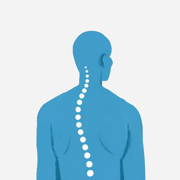
Thoracic mobility exercises for the stiff mid-back under rounded shoulders
Thoracic mobility exercises target the mid-back: the twelve rib-bearing vertebrae between your neck and your lower back. Sitting parks that region in one long forward curve, and it loses rotation and extension before anything else does. Four moves, repeated most days, keep it moving.
Why rounded-shoulder correctives stall after a few weeks
Wave one is almost always the same: a doorway pec stretch, plus rowing or band work for the mid-back. Most people feel a difference for a couple of weeks. Then it flattens out.
The reason is structural. Stretching the chest and strengthening the scapular retractors both assume the spine underneath can straighten. When the mid-thoracic segments have settled into a fixed flexed curve, the shoulder blades are being asked to sit back on a rounded surface. You can hold the position during a set; ten minutes later it's gone. A rounded-shoulders routine that only touches the muscles in front and behind works around the stiff part instead of through it. The front-tight, back-long pattern of upper crossed syndrome is a muscle story laid over joints that also stopped moving.
What the thoracic spine is built for
Twelve vertebrae, T1 through T12, each anchored to a pair of ribs. The rib cage buys stability and spends range — but not evenly. Thoracic facet joints sit closer to the frontal plane, which allows rotation and side bending; the lumbar facets below sit closer to the sagittal plane, which blocks most of that twist. Range-of-motion figures vary between sources, but the pattern holds: most trunk rotation comes from the thoracic spine, and the lower back contributes a small share.
Extension is the second job. This region sits in a natural kyphosis, so it will never extend the way a lumbar spine does, but it needs enough to let you reach overhead without the ribs flaring or the low back arching to compensate.
A desk removes both. The chair holds the mid-back in flexion for hours, the arms stay in front, and rotation never happens. Nothing is being injured — the tissue adapts to the range you use, which at a desk is close to none.
Four thoracic mobility exercises that cover both directions
Two moves on the floor, two you can do anywhere, including at your desk.
| Move | Mainly trains | Dose | Where |
|---|---|---|---|
| Foam roller extensions | Extension, one level at a time | 3–5 breaths at 3–4 spots | Floor |
| Open books | Rotation with the pelvis pinned | 8–10 per side | Floor |
| Thread the needle | Rotation plus scapular glide | 6–8 per side | Floor |
| Seated rotations | Rotation, upright and loaded | 8–10 per side | Chair |
Foam roller extensions for the upper back
Lie with a foam roller running across the upper back, just under the bottom tips of the shoulder blades and perpendicular to your spine. Hands behind your head to support the neck, elbows pointed in. Exhale and drape backward over the roller — a few inches of motion, not a full backbend — then come up. Three to five slow breaths, move the roller up about an inch, repeat across three or four spots.
Hips on the floor gives more control and less pressure; hips lifted loads the segment harder. Neither version rolls below the bottom of the rib cage. Foam roller work on the upper back is the most common of the thoracic extension exercises for a reason — it's the only one here that isolates a level at a time.
The open books exercise
Lie on your side, knees bent to roughly 90 degrees and stacked, top knee resting on a cushion so the pelvis can't follow you. Arms straight out in front at shoulder height, palms together. Exhale and sweep the top arm in a wide arc overhead and across to the other side, head and eyes following the hand. Stop where it stops without the knee lifting, then return. Eight to ten per side.
The knee is the whole exercise. If it peels off the cushion, the rotation has moved into the hips and lower back — the thing you were trying to avoid.
Thread the needle stretch
On hands and knees, hips stacked over your knees. Slide one arm under your body, palm up, until the shoulder and the side of your head rest on the floor. Exhale there, then unwind and reach the same arm toward the ceiling, following the hand with your eyes. Six to eight per side.
Hips over the knees biases the upper thoracic segments; sitting the hips back toward the heels biases the lower ones. The thread the needle stretch is worth doing both ways on different days.
Seated thoracic rotations
Sit tall, feet flat, knees together and pointed straight ahead. Cross your arms over your chest or rest your hands behind your head. Exhale and rotate to one side, turning your head with your chest, and stop where the knees would start to swing. Hold a beat, return, switch. Eight to ten per side takes about a minute. It's the least impressive move here and the most useful one, because it survives a workday.
How often, and the honest caveat
Most of what a single mobility session buys you is temporary. The range fades over hours rather than days, and a week off tends to leave you near where you started. Durable change comes from repetition across weeks, and it holds only while the repetition continues. These are upper back mobility exercises, not a permanent correction — the aim is that the mid-back never sits still long enough to stiffen.
That means floor work three or four times a week and seated rotations in short doses through the day. If remembering them is the hard part, Posture Reminder is a posture reminder app for iPhone and Apple Watch, and it can time the desk-chair rotations so the mid-back never gets a full day to stiffen.

Mistakes that make thoracic spine exercises feel like nothing
- Rolling too low. Below the rib cage you're extending the lumbar spine, which already gets plenty of extension from a chair.
- Hinging at one spot. If the motion collects where the rib cage ends, you're bending one joint repeatedly instead of spreading it across the region. Small range, several positions.
- Holding your breath. The ribs are part of these joints. Exhale into the position and the front of the rib cage stays down instead of flaring.
- Cranking with the arms. Hooking an elbow outside the knee to force a deeper twist adds leverage, not mobility.
When to ask someone instead
This is general information, not treatment advice. Mid-back or neck pain that's sharp, travels into an arm, comes with numbness, or wakes you at night deserves a clinician's opinion before you stretch it. So does a history of osteoporosis, vertebral fracture, or spinal surgery — extension over a foam roller isn't automatically appropriate there.
FAQ
How often should I do thoracic mobility exercises?
Most days, in small amounts. Floor work three or four times a week is enough, and seated rotations can happen daily because they cost a minute. Frequency matters more than the length of any one session.
Do foam roller extensions actually change posture?
They change available range, which is a different thing. Getting extension back makes an upright position possible without strain; holding it through the day is a separate habit that needs strength and reminders.
What's the difference between open books and thread the needle?
Open books is rotation with the pelvis locked by a stacked knee, lying on your side. Thread the needle starts on hands and knees and adds the shoulder blade sliding across the rib cage. Open books is easier to control; thread the needle reaches the shoulder too.
Can I do thoracic spine exercises at a desk?
Seated rotations, yes — those are the ones worth repeating through the day. Keep the knees still so the twist comes from the mid-back rather than the hips. The floor moves belong at either end of the day.
Free Posture Reminder tools
- Anterior Pelvic Tilt TestThis anterior pelvic tilt test turns standing side-view observations into a simple posture score and neutral-position cues. It is a non-diagnostic screen, not a clinical assessment.
- Desk Chair Height CalculatorEstimate a desk chair height range from your height and desk height, then check whether your current chair supports a workable seated posture.
- Forward Head Posture CheckerUse a side-profile photo to estimate your craniovertebral angle with two clicks. This posture checker is a rough self-check, not a diagnosis.
- Monitor Height Ergonomics CalculatorEnter your seated eye height, monitor height, screen height and viewing distance to compare your setup with monitor height ergonomics targets.
- Posture Assessment ScoreAnswer a few desk posture questions, add your seated minutes and breaks, and get a non-diagnostic score with the highest-impact setup habits to review.
- Proper Sitting Posture at Desk CheckerCompare your desk, chair and monitor dimensions with height-scaled targets for a practical 90-90-90 sitting setup.
- Standing Desk Converter PlannerPlan a conversion standing desk setup from your body height, current desk, monitors and laptop. Get the converter lift, minimum surface width and estimated load.
- Standing Desk Height CalculatorEstimate a comfortable starting height for your standing desk, monitor, chair and screen viewing distance. Enter your body height and shoe heel height in centimetres or inches.
- Standing Desk TimerSet a sit/stand pattern and work-block length, then follow a live countdown with the next switch time, full schedule and sitting and standing totals.
- Wall Test Posture CheckUse a wall test for posture to record four contact findings and two gap measurements. Get a rough posture score, plain-language suggestions and the finding to address first.
- Workspace Ergonomics CalculatorUse an ergonomics calculator to set a desk or keyboard height, seat height, monitor top and viewing distance for seated or standing work.