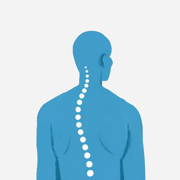
How to fix posture: find your fault, then train it
How to fix posture comes down to matching the work to the fault: find which of the four common patterns you have, then stretch what's tight and strengthen what's weak in that pattern. Generic exercise lists fail because the fixes for the four faults barely overlap. The routine below takes ten minutes.
The four posture faults, and a 60-second self-check
Take a side-on photo of yourself standing normally — phone on a shelf, timer running, eyes level, no posing. Then stand with your back to a wall, heels a couple of inches out, and note what touches. Nearly every desk-driven complaint is one or more of these four.
Forward head
Draw a vertical line down from your ear canal in the photo. If it lands ahead of the middle of your shoulder, the head is riding forward. At the wall, the tell is tipping your chin up to get the back of your head to touch. Short: suboccipitals, upper trapezius, levator scapulae, sternocleidomastoid. Weak: the deep neck flexors that hold the skull stacked over the ribs.
Rounded shoulders
Let your arms hang and look at your hands. Thumbs forward is roughly neutral; palms facing behind you means the shoulders have rolled in. Short: pec major and minor, lats, internal rotators. Weak: mid and lower trapezius, rhomboids, serratus anterior, external rotators.
Thoracic kyphosis
Some upper-back curve is normal — the fault is a curve you can't actively reverse. Lie face up with a foam roller across your mid-back and try to extend over it. If the ribs barely move and the motion comes from your lower back instead, the thoracic spine is the stiff link and the mid-back extensors have gone quiet.
Anterior pelvic tilt
Put your palms on the front of your pelvis: fingers on the bony points at the front, heels of your hands on the pubic bone. Fingers sitting well below your wrists means the pelvis is tipped forward. A small forward tilt is normal. The fault is a large tilt you can't voluntarily flatten, driven by tight hip flexors and lumbar extensors working against under-used glutes and deep abdominals.
| Fault | Quick check | Typically tight | Typically weak |
|---|---|---|---|
| Forward head | Ear ahead of the shoulder in a side photo | Suboccipitals, upper trap, levator scapulae | Deep neck flexors |
| Rounded shoulders | Palms face backward when the arms hang | Pecs, lats, internal rotators | Mid/lower trap, rhomboids, serratus, external rotators |
| Thoracic kyphosis | Can't extend over a foam roller without arching the low back | Front of the chest and rib cage, stiff thoracic joints | Thoracic extensors, mid-back |
| Anterior pelvic tilt | Front pelvic points sit well below the pubic bone | Hip flexors, lumbar erectors | Glute max, deep abdominals |
The first three are usually one problem wearing three hats — clinicians often group them as an upper crossed pattern. Anterior pelvic tilt is a separate project below the ribs.
How to fix posture in the right order: mobility before strength
You can't strengthen a muscle into a range you don't own. Pull the shoulders back with a stiff thoracic spine and a short pec minor and the movement gets stolen — the ribs flare, the low back arches, the neck cranes. Restore the range, load it, then rehearse the shape until it stops needing attention.
Each session runs mobility first, activation second, position practice third. That last step is the one people skip: after the reps, spend thirty seconds standing or sitting in a neutral spine so the new range attaches to a position you'll actually use. Postural muscles are endurance tissue, so higher reps and isometric holds beat heavy low-rep work here.
A 10-minute routine: posture correction exercises with sets and reps
The best exercises for posture aren't exotic. They're the ones aimed at your fault and repeated often enough to matter. If you have all four faults, run the whole thing; otherwise weight the blocks toward what your self-check found.
Mobilize — 3 minutes
- Foam roller thoracic extension. Roller across the mid-back, hands supporting the head, ribs down. Extend over it for 8–10 slow reps at two or three spots. ~60 s.
- Doorway pec stretch. Forearm on the frame at shoulder height, step through until the chest lengthens. 30 s per side. Drop the elbow to about 45° for a version that reaches pec minor. ~60 s.
- Half-kneeling hip flexor stretch. Back knee down, tuck the tailbone under and squeeze that glute before shifting forward. 30 s per side. ~60 s.
Strengthen — 5 minutes
- Chin tucks. Lying down or against a wall, slide the head straight back without lifting the chin. 10 reps, 5-second holds. ~60 s.
- Wall slides. Forearms on the wall, slide up and overhead keeping contact and keeping the ribs down. 2 × 8 slow reps. ~60 s.
- Band pull-aparts. Arms straight, pull to the chest, shoulder blades sliding down and back. 2 × 15. ~60 s.
- Glute bridges. Ribs down, 2-second squeeze at the top, no low-back arch. 2 × 12. ~60 s.
- Dead bugs. Low back pressed flat, opposite arm and leg reaching slowly. 2 × 8 per side. ~60 s.
Integrate — 2 minutes
Stand with heels a couple of inches from a wall and make glutes, upper back, and the back of the head touch without tipping the chin. Hold 30 s, three times. Then step away and keep the shape for 30 s while breathing normally. This is the rep that transfers.
Five or six days a week is a sensible dose.
Core exercises for posture that actually transfer
Crunches train trunk flexion — the shape you're trying to escape. The core exercises for posture are the anti-movement ones: dead bug for anti-extension, side plank for lateral stability, Pallof press for anti-rotation, bird dog for holding the trunk still while a hip and shoulder move. Each teaches the ribs to stay stacked over the pelvis while the limbs work, which is the job posture asks of the trunk at a desk or under a one-shoulder bag. Two or three sets of 20–40-second holds, or 8–10 controlled reps, is enough. When the rib position drifts, the set is over.
Ten minutes can't outvote ten hours
This is where most programs plateau. Ten minutes of corrective work against ten hours of sitting in the fault is losing arithmetic — the body defaults to the position it spends the most time in. The answer isn't more exercise, it's a shorter interval between resets. A prompt every 30 to 45 minutes that gets you to sit tall, drop the ribs, and stop leaning into the screen does more for your default than another set of pull-aparts. A sticky note works; so does an alarm. Posture Reminder, a posture reminder app for iPhone and Apple Watch, exists for the same reason — the cue arrives whether or not you remember to look.
How to improve posture while sitting
There's no single correct chair position, so aim for a default that doesn't force the faults — then change it often.
- Top of the monitor at or just below eye level, roughly an arm's length away. A laptop flat on the desk guarantees forward head; a stand plus an external keyboard fixes it.
- Elbows close to your sides at about 90–110°, forearms supported, shoulders resting down instead of shrugged.
- Hips level with or slightly above the knees, feet flat on the floor or a footrest.
- Backrest supporting the lumbar curve so you're not holding it with muscle all day.
- Get up before you stiffen — stand, walk, or reach overhead every half hour or so. The best sitting position is the next one.
What progress looks like, and when to get checked
Range returns first: the stretches stop biting after a week or two. Strength and endurance follow over a couple of months, and the resting default changes last, because it's a habit rather than a tissue. Knowing how to improve posture is rarely the bottleneck — repetition between sessions is.
This is general ergonomics guidance, not treatment. If you have pain, numbness, tingling, weakness, or symptoms traveling into an arm or leg, see a physical therapist or physician before working through a routine.
FAQ
How long does it take to fix bad posture?
Flexibility usually shifts within one to three weeks of daily work. Building enough endurance to hold the position without thinking about it takes longer, generally a couple of months of consistent practice. The stretches feel better long before the resting shape changes.
Do posture correctors and braces work?
As a short-term reminder, yes — a brace tells you where your shoulders are supposed to sit. It doesn't strengthen anything, and wearing one all day lets the muscles that should hold the position do less. Treat it as a cue for an hour or two, not as the plan.
Should posture exercises be done every day?
Mostly, yes. Mobility and activation work is low-load, and postural muscles respond to frequency more than intensity, so five or six days a week is reasonable. Heavier loaded work still needs its usual rest days.
Can you fix posture after 40 or 50?
Range of motion and strength improve with training at any age. What shifts is the ceiling — long-standing structural change in the spine can limit how far the shape corrects, so the realistic goal becomes more available range and better endurance rather than a textbook side profile.
Free Posture Reminder tools
- Anterior Pelvic Tilt TestThis anterior pelvic tilt test turns standing side-view observations into a simple posture score and neutral-position cues. It is a non-diagnostic screen, not a clinical assessment.
- Desk Chair Height CalculatorEstimate a desk chair height range from your height and desk height, then check whether your current chair supports a workable seated posture.
- Forward Head Posture CheckerUse a side-profile photo to estimate your craniovertebral angle with two clicks. This posture checker is a rough self-check, not a diagnosis.
- Monitor Height Ergonomics CalculatorEnter your seated eye height, monitor height, screen height and viewing distance to compare your setup with monitor height ergonomics targets.
- Posture Assessment ScoreAnswer a few desk posture questions, add your seated minutes and breaks, and get a non-diagnostic score with the highest-impact setup habits to review.
- Proper Sitting Posture at Desk CheckerCompare your desk, chair and monitor dimensions with height-scaled targets for a practical 90-90-90 sitting setup.
- Standing Desk Converter PlannerPlan a conversion standing desk setup from your body height, current desk, monitors and laptop. Get the converter lift, minimum surface width and estimated load.
- Standing Desk Height CalculatorEstimate a comfortable starting height for your standing desk, monitor, chair and screen viewing distance. Enter your body height and shoe heel height in centimetres or inches.
- Standing Desk TimerSet a sit/stand pattern and work-block length, then follow a live countdown with the next switch time, full schedule and sitting and standing totals.
- Wall Test Posture CheckUse a wall test for posture to record four contact findings and two gap measurements. Get a rough posture score, plain-language suggestions and the finding to address first.
- Workspace Ergonomics CalculatorUse an ergonomics calculator to set a desk or keyboard height, seat height, monitor top and viewing distance for seated or standing work.