Best 9 Posture AI Alternatives in 2026: Apps That Actually Work
If you’re searching for posture ai alternatives that skip experimental AI in favor of practical, everyday nudges, Posture Reminder: Back Health is our top pick. Below we’ve tested apps that quietly help you sit and stand a little better. No wearables, no complex sensors, just real help across iOS and Android.
Quick comparison table
| App | Platform | Key Feature | Best For |
|---|---|---|---|
| Posture Reminder | iOS | Timed stand-up reminders | Busy desk workers |
| Muscle & Motion: Posture | iOS | 3D anatomy models | Visual learners |
| Perfect Posture - Back Care | iOS | 200+ equipment-free exercises | Home exercisers |
| SmartPosture | Android | Screen blurring alerts | Android scrollers |
| Align - Fix Your Posture | iOS | Progress-tracking charts | Progress trackers |
| PostureLens | Android | Real-time CVA angle | Tech-neck measurement |
| The Posture Pension | Android | Seated muscle activation | Unconscious habit building |
| PostureScreen Mobile | iOS | Clinical assessment tools | Clinicians & PTs |
| Stay Straight | Android | Battery-friendly angle monitoring | Minimalist slouch alerts |
1. Posture Reminder
Best for: busy desk workers who want posture habits that run on autopilot.
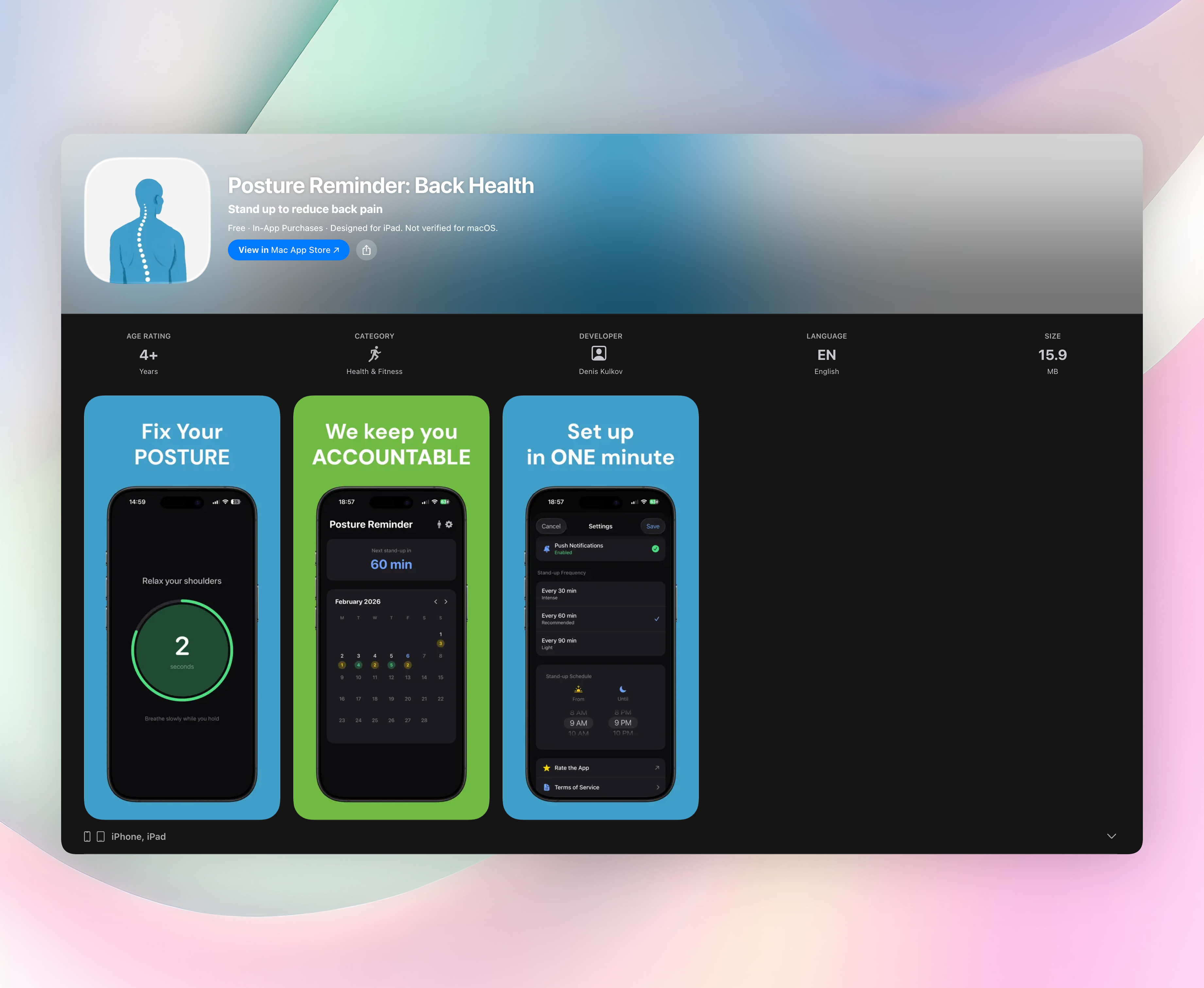
Posture Reminder works without a camera, AI, or wearables. It simply sends you gentle stand-up and stretch breaks at intervals you set (every 20, 60, or 120 minutes). It’s not a one-time fix. Instead, it builds a daily rhythm that reminds your body to reset. That helps reduce stiffness and mindless slouching over long screen sessions. The standout feature is customizable break intervals that adapt to your schedule, so you’re nudged only when you want to be.
- Pick your reminder schedule (morning to evening)
- Choose how often: 20, 60, or 120 minutes
- Quick 10-, 20-, or 30‑second stand screen
- Morning reminder plus a follow-up if you miss one
- Calendar view with streaks, no account needed
Get Posture Reminder · Posture Reminder on the App Store
2. Muscle & Motion: Posture
Best for: visual learners who want to understand the anatomy behind their alignment.
This app uses a 3D platform to show muscles, joints, and postural imbalances in high detail. You can rotate musculoskeletal models to see exactly where tightness or weakness contributes to slouching. A corrective exercise library rooted in biomechanics helps you translate that knowledge into action. The standout is the fully rotatable 3D model. It turns an abstract “straighten up” cue into something you can see and study.
3. Perfect Posture - Back Care
Best for: home exercisers who’d rather fix posture with yoga and pilates.
Over 200 equipment‑free exercises sit alongside 30‑day workout plans, giving you a clear path away from slouching. The focus is spinal health through strengthening and mobility, and daily reminders keep the routine from fizzling out. The standout feature is structured 30‑day posture challenges that take the guesswork out of which exercise to do tomorrow.
4. SmartPosture = Healthy Posture
Best for: Android users who slouch during long scrolling sessions and want an immediate nudge.
SmartPosture runs unobtrusively in the background and reacts to phone‑use patterns tied to text neck. It offers customizable alerts like vibration, screen blurring, or a simple notification the moment you dip into a slouched position. The standout is the screen blurring: it forces you to straighten up to see clearly, turning posture correction into an instinct.
5. Align - Fix Your Posture
Best for: progress trackers who need to see measurable gains over time.
Align provides daily exercises and custom reminders, then turns your consistency into visual progress charts. It’s built to reduce back pain through steady habit formation, not quick fixes. The standout feature is clear graphs that chart long‑term posture improvement, so you can watch the trend line move in the right direction.
6. PostureLens: AI Posture Coach
Best for: tech‑neck sufferers who want objective, real‑time angle data.
PostureLens uses your phone’s camera and on‑device AI to measure your Craniovertebral Angle (CVA), a direct indicator of forward head posture. No wearables, just a quick self‑check that gives you a number to work with. The standout feature is the live CVA reading, letting you see instantly if your head is creeping forward and by how much.
7. The Posture Pension
Best for: anyone who wants unconscious posture habits instead of constant alerts.
Rather than buzzing you every few minutes, The Posture Pension guides you through simple seated exercises and deep muscle activation. The app quietly builds subtle corrections into your everyday movements, easing back, neck, and shoulder strain. The standout is guided sequences that train deep stabilizers so good posture becomes automatic.
8. PostureScreen Mobile
Best for: clinicians and physical therapists needing objective assessments.
This is a clinical‑level tool for posture analysis, reliability measurements, and patient outcome documentation. It doesn’t pretend to be a casual coach. It’s built for professionals who quantify forward head, shoulder elevation, and lateral shifts in practice. The standout is its advanced assessment toolkit, far more detailed than a consumer reminder app.
9. Stay Straight - Posture App
Best for: Android minimalists who want slouch alerts without battery drain.
Stay Straight continuously monitors your phone’s angle and sends gentle, non‑intrusive notifications when you start to slump. It’s deliberately stripped down to stay easy on the battery while building habitual awareness over weeks of use. The standout feature is battery‑friendly angle monitoring that runs all day without you having to babysit a sensor.
How we picked these apps
We looked for posture apps that correct behavior without requiring AI‑only sensors or wearables. Our testing favored tools that run quietly in the background and don’t wreak havoc on battery life. We paid attention to whether reminders felt helpful or just annoying after a day. Setup had to be simple. If we couldn’t get it running in a few minutes, it didn’t make the cut. We specifically sought solutions that addressed forward head, rounded shoulders, and the stiffness that comes from sitting too long. While we considered cross‑platform availability, we didn’t rule out Android‑only or iOS‑only picks as long as they did one thing exceptionally well. Apps demanding proprietary hardware or a smart garment got dropped early.
Frequently Asked Questions
Can an AI posture app work without a wearable?
Yes, camera‑based apps like PostureLens measure angles directly without any accessory. That said, simple reminder‑driven apps like Posture Reminder often work just as well for building lasting habits, because they don’t depend on you opening the camera multiple times a day.
Is it safe to rely on a phone camera for posture analysis?
Apps like PostureLens process everything on‑device, so your video doesn’t leave your phone. Still, no camera‑based tool provides a medical diagnosis; these apps are for awareness and habit support, not a replacement for a PT or orthopedic assessment.
Which app is the simplest for daily reminders?
Posture Reminder is the most straightforward. No camera, no exercises, no analysis. You set a schedule, and it gives timed nudges to stand or stretch. If you want the lowest‑effort way to break up sitting marathons, it’s the cleanest option compared to feature‑heavy posture tools.
The verdict
If you came here looking for posture ai alternatives that are reliable, fuss‑free, and actually stick, Posture Reminder: Back Health is the app to reach for. It doesn’t need a camera, doesn’t run AI, and won’t ask you to do a single exercise. It simply weaves short stand‑up breaks into your day until better posture feels natural. It’s the only app in this guide with a direct download link right here: Posture Reminder on the App Store. Give it a try. A few well-timed breaks can be all it takes.
Free Posture Reminder tools
- Anterior Pelvic Tilt TestThis anterior pelvic tilt test turns standing side-view observations into a simple posture score and neutral-position cues. It is a non-diagnostic screen, not a clinical assessment.
- Desk Chair Height CalculatorEstimate a desk chair height range from your height and desk height, then check whether your current chair supports a workable seated posture.
- Forward Head Posture CheckerUse a side-profile photo to estimate your craniovertebral angle with two clicks. This posture checker is a rough self-check, not a diagnosis.
- Monitor Height Ergonomics CalculatorEnter your seated eye height, monitor height, screen height and viewing distance to compare your setup with monitor height ergonomics targets.
- Posture Assessment ScoreAnswer a few desk posture questions, add your seated minutes and breaks, and get a non-diagnostic score with the highest-impact setup habits to review.
- Proper Sitting Posture at Desk CheckerCompare your desk, chair and monitor dimensions with height-scaled targets for a practical 90-90-90 sitting setup.
- Standing Desk Converter PlannerPlan a conversion standing desk setup from your body height, current desk, monitors and laptop. Get the converter lift, minimum surface width and estimated load.
- Standing Desk Height CalculatorEstimate a comfortable starting height for your standing desk, monitor, chair and screen viewing distance. Enter your body height and shoe heel height in centimetres or inches.
- Standing Desk TimerSet a sit/stand pattern and work-block length, then follow a live countdown with the next switch time, full schedule and sitting and standing totals.
- Wall Test Posture CheckUse a wall test for posture to record four contact findings and two gap measurements. Get a rough posture score, plain-language suggestions and the finding to address first.
- Workspace Ergonomics CalculatorUse an ergonomics calculator to set a desk or keyboard height, seat height, monitor top and viewing distance for seated or standing work.