Best 9 Muscle & Motion Posture Alternatives in 2026: Apps That Straighten You Up
Introduction
Posture Reminder is the best muscle & motion posture alternative for anyone who wants gentle, habit-building nudges without extra hardware. This list covers nine mobile apps, from simple reminders to clinical assessment tools, so you can pick the right fit for your needs.
Quick comparison table
| App | Best for | Platform | Price |
|---|---|---|---|
| Posture Reminder | Daily stand‑up reminders & habit tracking | iOS | Free |
| UPRIGHT | Real‑time feedback with a wearable sensor | iOS, Android | Paid (hardware required) |
| Stay Straight | Background slouch detection on Android | Android | Free |
| Text Neck – Posture Correction | Corrective exercises for forward head posture | iOS, Android | Freemium |
| Perfect Posture | Guided stretching & strengthening routines | iOS, Android | Freemium |
| APECS | Professional photographic posture analysis | iOS, Android | Paid |
| PhysioMaster | Therapist‑focused range of motion measurement | Android | Freemium |
| PostureScreen Lite | Quick movement dysfunction screening | iOS, Android | Freemium |
| SmartPosture™ | Screen‑time & angle tracking for habit awareness | Android | Free |
1. Posture Reminder
Best for: building a daily posture habit with timed stand‑up breaks.
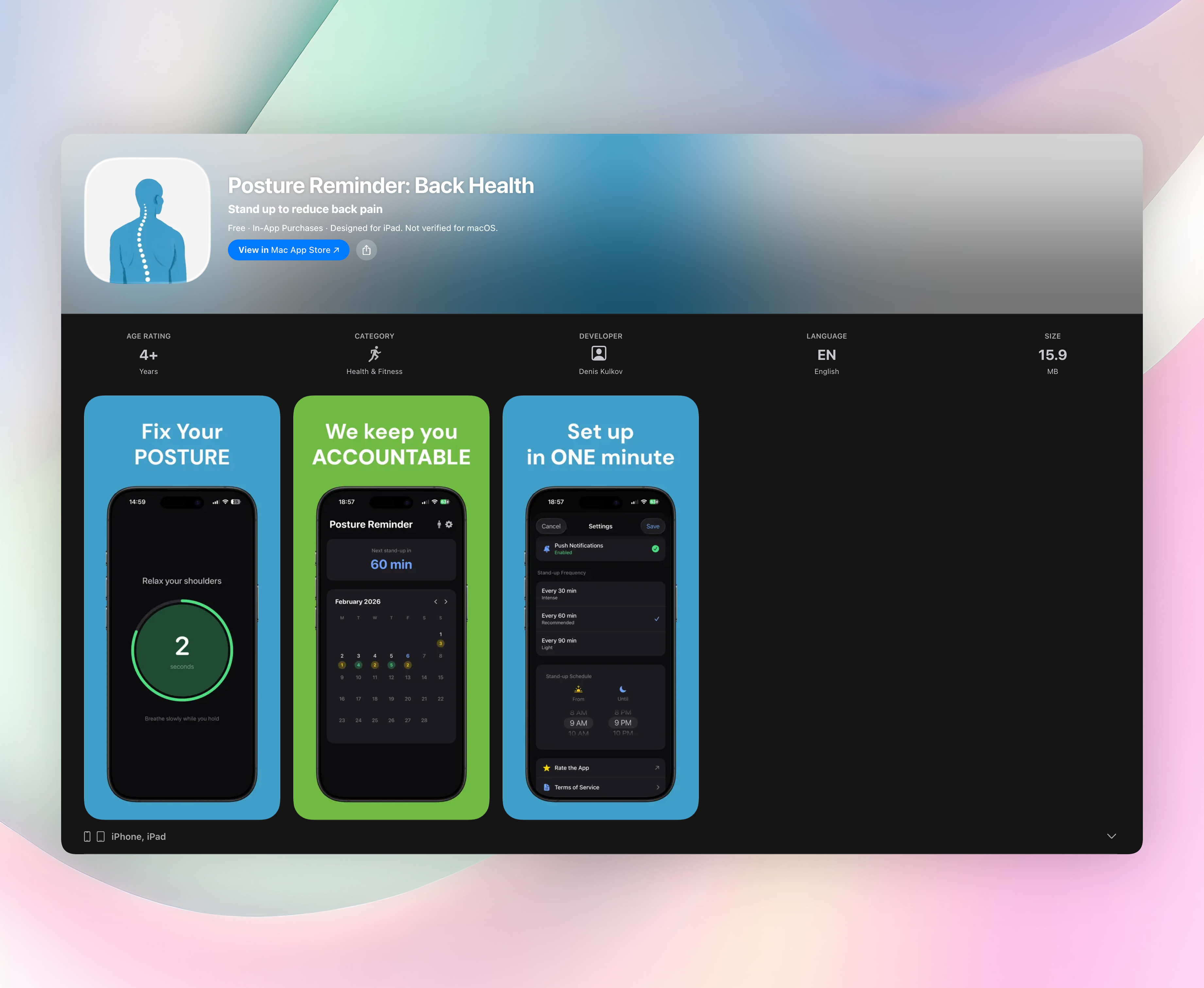
Posture Reminder works like a friendly tap on the shoulder, not a lecture. You choose a window (morning to evening) and how often it nudges you: every 20, 60, or 120 minutes. When it’s time, a quick stand‑up screen pops up with clear guidance. Ten, twenty, or thirty seconds later you’re back to your day.
What makes it the muscle & motion posture alternative that actually sticks is the simplicity. There’s no sensor to calibrate, no posture‑score anxiety. The app runs quietly on iOS, barely touches your battery, and respects your space after each nudge. Custom intervals sync with your work/rest rhythm, so consistency stops feeling like a chore. A morning reminder plus an optional follow‑up if you miss one keep the streak going without pressure.
- Set your own reminder schedule and break frequency
- 10‑, 20‑, or 30‑second stand‑up screens
- Calendar view and streak tracking, no account needed
- Lightweight, no background drain, no pestering
Get Posture Reminder · Posture Reminder on the App Store
2. UPRIGHT
Best for: people ready to invest in a wearable sensor for all‑day feedback.
UPRIGHT pairs a small device you stick on your back with a companion app. When you slouch, the sensor vibrates, and the app logs your posture score, delivers training programs, and shows progress over time. It’s less about one‑off reminders and more about gradually strengthening the muscles that keep you upright. The trade‑off is the upfront hardware cost, but for anyone who wants constant, hands‑free coaching, it’s the closest thing to a posture coach in your pocket.
3. Stay Straight
Best for: Android users who’d rather the phone watch their posture unnoticed.
Stay Straight runs in the background and reads your phone’s tilt angle continuously. The moment you drop into a slouch, it fires a subtle notification. No buzz, no lock‑screen takeover. You don’t need to keep the app open, and it sips battery carefully. It’s a set‑and‑forget option for people who want a gentle nudge without actively thinking about their posture all day. Free and simple, it’s a solid first step away from text‑neck.
4. Text Neck – Posture Correction
Best for: anyone battling forward head posture and tech‑related neck stiffness.
This app attacks the “text neck” problem directly with corrective exercises built around reversing screen‑slump habits. Instead of just telling you to sit up, it guides you through a few minutes of strengthening and stretching routines per day. The targeted moves help pull the head back into alignment and relieve tension. It’s beginner‑friendly and available on both iOS and Android, making it a natural companion if your phone is both the cause and the cure.
5. Perfect Posture – Posture Correction Exercises
Best for: people who prefer guided video workouts over reminders.
Perfect Posture focuses on spinal alignment through progressive stretching and strengthening sessions. You’ll find options ranging from 5‑minute wake‑up sequences to fuller routines you can do at your desk or on the floor. No equipment needed, just follow along. The video‑based format and varied playlists make it feel less like a corrective chore and more like a mini wellness break. Available on iOS and Android with free and premium content.
6. APECS: Body Posture Evaluation
Best for: physical therapists and pros running detailed posture assessments.
APECS uses specialized photo markers and algorithms to generate precise body alignment reports. You take pictures with markers on anatomical landmarks, and the app processes deviations and angles. It’s not a daily reminder app. This tool lives in clinics and studios where trainers or physios need objective, repeatable evaluations. If you want periodic, data‑rich reports on how your posture is changing, APECS delivers professional‑grade analysis.
7. PhysioMaster: Posture & ROM
Best for: clinicians and patients measuring joint range of motion.
PhysioMaster digitizes what a goniometer does on paper. It lets therapists capture posture and joint angle measurements directly on an Android device, then track changes over treatment sessions. The toolkit covers posture, range of motion, and even includes exercises. It’s clearly designed for clinical workflows, not for casual daily use. If you’re working with a physio who wants objective numbers instead of eyeballing it, this bridges the gap.
8. PostureScreen Lite
Best for: quick screening of movement dysfunctions by fitness and medical pros.
PostureScreen Lite lets you snap front, back, and side photos, then generates deviation reports that spot asymmetries and potential issues. The lite version gives a cost‑effective way to trial before upgrading to the full suite. It runs on both iOS and Android and serves as an assessment checkpoint, not a daily nudge tool. Think of it as a baseline scan you revisit every few weeks to see if corrective work is paying off.
9. SmartPosture™
Best for: linking posture awareness to your screen‑time habits.
SmartPosture monitors how long you use your phone and at what angle you hold it. When you’ve been staring down too long, a customizable reminder says it’s time to reset. The interface is bare‑bones: you set your thresholds, then forget about it. It’s Android‑only, free, and works best for folks who want a direct line from “I’m doomscrolling again” to “time to lift my head.” Nothing flashy, just a simple habit tracker.
How we picked these apps
Criteria
We filtered for three things: actionable daily nudges that actually change behavior, evidence‑backed exercise programs, and professional assessment accuracy. A few dozen apps were tested, and we dropped anything with intrusive ads, unreliable tilt sensors, or posture guidelines that felt vague or made‑up.
Testing notes
Each app was installed on a real device and used for at least three days. Professional tools were cross‑checked against feedback from physical therapists and user reviews to confirm they deliver what pros expect.
What we excluded
Apps that demanded pricey mandatory subscriptions with no free tier, or that crashed during setup, didn’t make the cut. The list favors apps that let you start immediately without a paywall.
Frequently asked questions
Can a posture app actually fix my back pain?
Apps can increase awareness and deliver exercises that often reduce discomfort, but they aren’t a substitute for medical diagnosis. Pairing an app with ergonomic adjustments, like monitor height and chair setup, gives the best practical result.
Do I need a wearable device for these apps?
Most picks work with just your phone. Only UPRIGHT requires a separate sensor. Phone‑based angle detection (used by Stay Straight and SmartPosture) handles desk‑bound slouching well without a gadget clipped to your back.
How does this list compare to Muscle & Motion?
Muscle & Motion is an educational anatomy platform. It shows you how muscles move, but it doesn’t track or correct your posture in real time. The apps here are practical companions for people who already understand the anatomy and want daily tools that actively nudge or assess.
The verdict
For most people searching muscle & motion posture alternatives, Posture Reminder is the simplest, most reliable pick to build a lasting habit without extra gadgets. Its battery‑friendly reminders fit into any routine, and it never overstays its welcome. The right app depends on your goal: wearable feedback, corrective exercises, or professional assessments. If you want a gentle, consistent nudge that actually sticks, start here. Get Posture Reminder.
Free Posture Reminder tools
- Anterior Pelvic Tilt TestThis anterior pelvic tilt test turns standing side-view observations into a simple posture score and neutral-position cues. It is a non-diagnostic screen, not a clinical assessment.
- Desk Chair Height CalculatorEstimate a desk chair height range from your height and desk height, then check whether your current chair supports a workable seated posture.
- Forward Head Posture CheckerUse a side-profile photo to estimate your craniovertebral angle with two clicks. This posture checker is a rough self-check, not a diagnosis.
- Monitor Height Ergonomics CalculatorEnter your seated eye height, monitor height, screen height and viewing distance to compare your setup with monitor height ergonomics targets.
- Posture Assessment ScoreAnswer a few desk posture questions, add your seated minutes and breaks, and get a non-diagnostic score with the highest-impact setup habits to review.
- Proper Sitting Posture at Desk CheckerCompare your desk, chair and monitor dimensions with height-scaled targets for a practical 90-90-90 sitting setup.
- Standing Desk Converter PlannerPlan a conversion standing desk setup from your body height, current desk, monitors and laptop. Get the converter lift, minimum surface width and estimated load.
- Standing Desk Height CalculatorEstimate a comfortable starting height for your standing desk, monitor, chair and screen viewing distance. Enter your body height and shoe heel height in centimetres or inches.
- Standing Desk TimerSet a sit/stand pattern and work-block length, then follow a live countdown with the next switch time, full schedule and sitting and standing totals.
- Wall Test Posture CheckUse a wall test for posture to record four contact findings and two gap measurements. Get a rough posture score, plain-language suggestions and the finding to address first.
- Workspace Ergonomics CalculatorUse an ergonomics calculator to set a desk or keyboard height, seat height, monitor top and viewing distance for seated or standing work.