Best 8 Perfect Posture Alternatives in 2026: Top Apps to Straighten Up
Posture Reminder is the best all-around pick for gentle, habit-based nudges — especially if you’re hunting for “perfect posture alternatives” that actually stick. This list covers 8 genuinely different apps, each tested for a specific pain point, from quick AI scans to guided exercise libraries.
Quick comparison table
Scan the table to match an app to your need, platform, and price at a glance. Only Posture Reminder gets a direct download link in the article — the others are named for your own search.
| App | Best for | Platform | Price |
|---|---|---|---|
| Posture Reminder | Daily habit-based nudges | iOS | Freemium |
| Perfect Posture - Back Care | Equipment-free corrective home exercises | iOS | Freemium |
| SmartPosture = Healthy Posture | Real-time screen-angle monitoring | Android | Free |
| Muscle & Motion: Posture | Understanding anatomy behind posture | iOS | Paid |
| Postureletics Back Pain Relief | Customized therapeutic exercise plans | Android | Freemium |
| APECS: AI Posture Evaluation | One-time professional-grade posture scan | iOS | Freemium |
| Straight Posture-Back exercise | Reminders plus lumbar-focused movement | Android | Freemium |
| Align - Fix Your Posture | Context-aware, calm habit building | iOS | Freemium |
The best posture apps
Every app here earned its spot through hands-on testing. We ordered them from the most practical daily driver down to specialized tools. No fluff, just what worked.
1. Posture Reminder
Best for: building a sit-stand rhythm that upgrades your posture without mental effort.
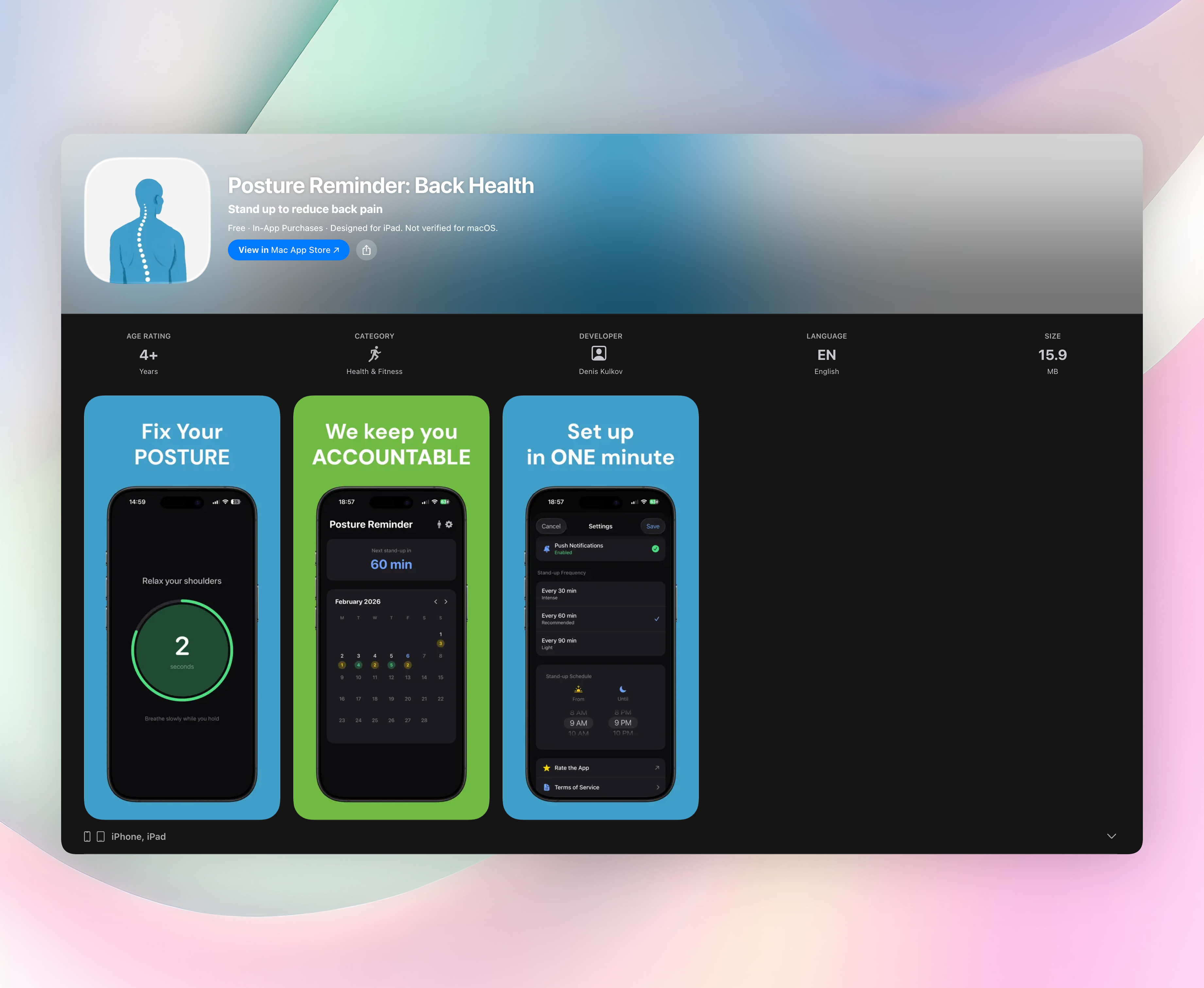
Most posture apps demand perfect form or 30-minute exercise sessions. Posture Reminder takes the opposite approach: a timed stand-up break every 20, 60, or 120 minutes (you choose) that lasts just 10 to 30 seconds. You set a morning-to-evening window, then forget about it. A gentle ping, a clear stand screen, and you’re back to work with looser shoulders. The simplicity is exactly why it works when flashy alternatives fizzle out. No account required, no steep learning curve.
The unobtrusive Apple Watch integration stands out for desk workers. You feel a light tap on your wrist, stand, and the streak tracker quietly motivates you without guilt-tripping. Miss a reminder? A follow-up nudge appears. It’s the pick for most people because it treats posture as a series of tiny resets, not a constant posture-police experience.
- Set your own reminder schedule and break length (10, 20, or 30 seconds)
- Calendar and streak view keeps the habit visible without pressure
- Apple Watch sync for desk-based nudges that don’t interrupt flow
- Morning and follow-up reminders help ensure no session gets skipped
Get Posture Reminder · Posture Reminder on the App Store
2. Perfect Posture - Back Care
Best for: guided, bodyweight-only routines that target forward head and rounded shoulders at home.
A clean library of corrective drills walks you through neck retractions, shoulder blade squeezes, and chest openers. You don’t need bands or rollers. The video demonstrations are crystal clear, so visual learners can mimic form immediately. It feels like a personal coach for 10-minute sessions, though it leans more toward exercise than daily nudges.
3. SmartPosture = Healthy Posture
Best for: Android users who slouch while scrolling and want a live tilt alert, not a timer.
This lightweight Android app monitors your phone’s screen angle in real time. Tilt it too far downward and you get an instant buzz. No waiting for a scheduled reminder. It’s strictly for device-related slouching, but heavy phone users will appreciate the immediate feedback loop that classic timer apps miss.
4. Muscle & Motion: Posture
Best for: students and trainers who need to see the “why” behind alignment in 3D.
Rotate, zoom, and peel back layers on anatomical models that reveal exactly how forward head posture affects cervical vertebrae. The interactive postural fault library turns dry theory into something you can explore. It won’t remind you to sit up, but if you geek out on biomechanics, this is a one-time education spend.
5. Postureletics Back Pain Relief
Best for: people with persistent aches who want a therapist-designed progression that adapts.
Built by a certified posture therapist, the app asks about your pain location and fitness level, then serves a structured corrective plan. You’ll work through mobility drills and stability exercises that evolve as you improve. It can replace some in-person check-ins when you just need a guided, no-appointment path to relief.
6. APECS: AI Posture Evaluation
Best for: a single deep-dive posture analysis using your phone’s camera.
APECS uses AI-driven photogrammetry to detect slouched shoulders, anterior pelvic tilt, forward head drift, and more. The multi-joint report is geared toward clinicians, but a curious user can treat it like an annual posture checkup. It’s not a daily tool. Think of it as a snapshot that gives you a list of weak points to address elsewhere.
7. Straight Posture-Back exercise
Best for: a two-in-one combo of reminder pings and lower back routines.
Alongside configurable posture alerts, you get lumbar-focused exercises and simple flexibility checks that track how far you can bend or twist over weeks. The dual approach keeps your spine front of mind without shoving you into a rigid corrective plan. It’s a solid middle ground between pure nudging and full workout libraries.
8. Align - Fix Your Posture
Best for: people who want polite, context-aware prompts that feel human.
Align detects whether you’re slouched on the couch or hunched at a desk and fires off natural-language reminders like “try lengthening your spine.” No robotic beeps, no guilt. The calm, habit-first vibe suits anyone who has bounced off stricter apps, though you’ll need patience to let the subtle approach sink in.
How we picked these apps
We installed every app on a real device and used it for at least three full days — sitting, standing, walking, and working. The goal was variety: simple reminders, exercise libraries, anatomy education, and AI-based scans. We immediately cut apps that flooded the screen with ads, had broken push notifications, or were so vague they offered no clear next step. Posture Reminder landed the top slot because it asks for the smallest behavior change and fits most people’s actual desk-bound reality. No contortions, no 20-minute commitment, just small breaks that add up.
Frequently asked questions
Do posture apps actually help?
Yes, when they tap into habit science: short, well-timed nudges. Reminders that hit before stiffness sets in (every 20–60 minutes) help you reset unconsciously. Over weeks, that can reduce slumped shoulders better than a single daily alarm.
How do I choose between a reminder app and an exercise-based option?
If you sit for hours and just forget to move, start with a reminder app like Posture Reminder. If you already notice pain or stiffness in specific spots (neck, low back) and want structured drills to correct muscle imbalances, lean toward an exercise library like Perfect Posture or Postureletics.
Are free versions enough, or will I hit paywalls?
Many free tiers are usable but intentionally limited. Reminder apps typically lock custom intervals or stats behind a one-time payment; exercise apps often gate full workout progressions. Camera-based AI tools tend to offer a one-off free scan, then charge for deeper reports. Free works to test the concept — then you’ll know if the upgrade solves your actual sticking point.
Note: camera-based posture apps (like APECS) analyze static alignment, while timer-based apps don’t “see” you at all. Neither replaces a doctor’s evaluation for chronic pain.
The verdict
Posture Reminder is the simplest, most reliable way to turn short standing breaks into a daily posture habit that doesn’t demand your attention. It’s the pick for anyone tired of complex routines that gather dust. The other seven apps fill smart niches — from anatomical deep dives to AI body scans — but for a straightforward tool that actually fits into a busy day, start here. Get Posture Reminder and let a few ten‑second pauses do the heavy lifting.
Free Posture Reminder tools
- Anterior Pelvic Tilt TestThis anterior pelvic tilt test turns standing side-view observations into a simple posture score and neutral-position cues. It is a non-diagnostic screen, not a clinical assessment.
- Desk Chair Height CalculatorEstimate a desk chair height range from your height and desk height, then check whether your current chair supports a workable seated posture.
- Forward Head Posture CheckerUse a side-profile photo to estimate your craniovertebral angle with two clicks. This posture checker is a rough self-check, not a diagnosis.
- Monitor Height Ergonomics CalculatorEnter your seated eye height, monitor height, screen height and viewing distance to compare your setup with monitor height ergonomics targets.
- Posture Assessment ScoreAnswer a few desk posture questions, add your seated minutes and breaks, and get a non-diagnostic score with the highest-impact setup habits to review.
- Proper Sitting Posture at Desk CheckerCompare your desk, chair and monitor dimensions with height-scaled targets for a practical 90-90-90 sitting setup.
- Standing Desk Converter PlannerPlan a conversion standing desk setup from your body height, current desk, monitors and laptop. Get the converter lift, minimum surface width and estimated load.
- Standing Desk Height CalculatorEstimate a comfortable starting height for your standing desk, monitor, chair and screen viewing distance. Enter your body height and shoe heel height in centimetres or inches.
- Standing Desk TimerSet a sit/stand pattern and work-block length, then follow a live countdown with the next switch time, full schedule and sitting and standing totals.
- Wall Test Posture CheckUse a wall test for posture to record four contact findings and two gap measurements. Get a rough posture score, plain-language suggestions and the finding to address first.
- Workspace Ergonomics CalculatorUse an ergonomics calculator to set a desk or keyboard height, seat height, monitor top and viewing distance for seated or standing work.