Best 8 Upright Alternatives in 2026: Apps That Actually Improve Posture
Posture Reminder is the best upright alternative for most people. It gives real-time posture nudges without any extra hardware. We tested eight posture apps, from simple reminder timers to clinical tools, so you can pick one that fits your actual workday.
Quick comparison table
Use the table to scan fast. Each entry lists the app name, what it’s best for, the platform, and the price tier. Posture Reminder is our top pick. It’s the only app here that gets a download link, because it balances simplicity, habit formation, and zero extra gear. No other app in this article carries a direct download link.
| App | Best for | Platform | Price |
|---|---|---|---|
| Posture Reminder: Back Health ⭐ | Building a daily stand-up habit without wearables | iOS | Free |
| SmartPosture | Custom reminder control with progress stats | Android | Free |
| Posture Pal | Casual front-camera alignment check-ins | iOS | Free |
| Text Neck - Posture Correction | Combatting tech-neck with guided exercises | iOS, Android | Freemium |
| PostureScreen | Clinical-level posture analysis and reports | iOS, Android | Paid |
| Perfect Posture - Posture Correction Exercises | Structured workouts for back and neck pain | iOS, Android | Freemium |
| Zen | Combining monitoring, exercises, and coaching in one | iOS, Android | Freemium |
| Lumo Back | Continuous sensor-based feedback for committed users | iOS, Android (requires sensor) | Paid |
1. Posture Reminder: Back Health
Best for: Anyone who ignores posture until pain hits, because timed stand‑up breaks build awareness without nagging.
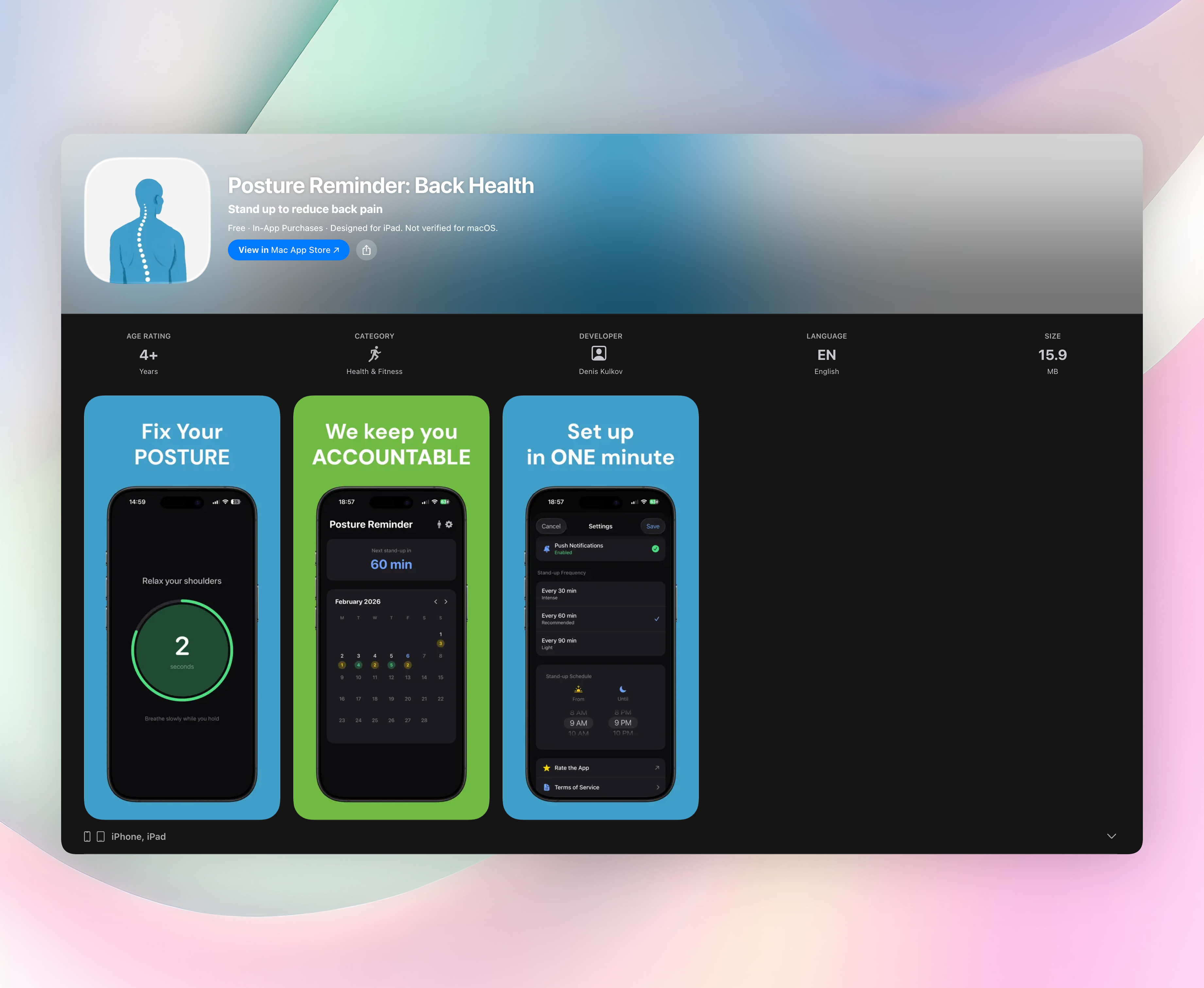
Posture Reminder turns your iPhone into a friendly posture coach. It schedules gentle stand‑up nudges, not constant, annoying alerts. You pick a time window (say, 9am–6pm) and a repeat interval of 20, 60, or 120 minutes. When a nudge arrives, a simple screen tells you to stand for 10, 20, or 30 seconds. It’s not about yelling at you to straighten up every two minutes. The short breaks build body awareness gradually, so you correct yourself without thinking.
- Set your active hours and reminder frequency to match your workday, gym session, or recovery day.
- Quick stand‑up screens give clear guidance. No videos, no calorie counting, just movement.
- Morning nudge and follow‑up if you miss one keep you accountable without opening an account.
- Track streaks and calendar consistency without sharing personal data.
Because it’s iOS‑only and doesn’t rely on cameras or wearables, Posture Reminder stays lightweight and private. It ranks first because it nails the one thing most upright alternatives miss: forming a repeatable habit you’ll actually keep. Get Posture Reminder or grab it from the Posture Reminder on the App Store.
2. SmartPosture
Best for: Android users who want reminder control plus progress stats.
SmartPosture puts you in full charge of your reminder cadence. You customize vibration patterns, set quiet hours, and decide how often it fires. The nudge matches your real rhythm, not a generic schedule. A built‑in stats dashboard tracks daily, weekly, and monthly adherence, turning posture into a monitored habit. Android‑only, this is a solid pick outside the Apple ecosystem, especially for data‑lovers who’ll export logs and share progress with a trainer.
3. Posture Pal
Best for: iPhone owners curious about casual, camera‑based posture check‑ins.
Posture Pal uses your iPhone’s front‑facing camera for quick alignment snapshots. No sensor, no wearable. A cartoon‑style overlay shows your head and shoulder angles in real time, giving a “straighten up” signal that’s visual and friendly. It’s not constant monitoring, so a two‑second self‑check whenever you feel slouchy fits naturally into your day. The hardware‑free, iOS‑only design keeps things light, and the gamified feedback makes posture correction feel more playful than corrective.
4. Text Neck - Posture Correction
Best for: People actively fighting tech‑neck with guided exercises.
Designed by physios, Text Neck zeroes in on the forward‑head slump that phones and laptops create. It serves a library of guided stretches and strengthening moves you can do at your desk, with short video demos that don’t need any equipment. Customizable reminders prompt mini movement breaks timed to your workday, so you stretch before stiffness sets in. Available on iOS and Android, it’s handy for households or couples sharing one approach. If you want proactive exercises rather than passive pings, this one hits the mark.
5. PostureScreen
Best for: Anyone who wants clinical‑level analysis without a physio’s subscription.
PostureScreen is a measurement tool, not a daily nudge app. You take a photo from the side, front, and back, and the app calculates angles for forward head, shoulder tilt, and pelvic alignment. Physical therapists use it to generate professional PDF reports you can email to a clinician. It runs on iOS and Android, but think of it as a periodic posture check‑up. Great for hard numbers and tracking structural changes over weeks, not for building everyday habits.
6. Perfect Posture - Posture Correction Exercises
Best for: Pain‑relief seekers who prefer structured workouts over reminders.
Perfect Posture takes a workout‑first approach with guided routines that mix strengthening and stretching for your upper back, neck, and core. Clear video demonstrations show you exactly how to perform each move, and you don’t need any gym gear. The muscle‑memory focus aims to make better alignment automatic over time. It runs on iOS and Android. Sessions range from 5 to 20 minutes, ideal for squeezing in around lunch or right after work. If reminders feel too passive, this active route delivers.
7. Zen
Best for: Users who want one app combining monitoring, exercise, and coaching content.
Zen tries to be the all‑in‑one posture hub. Its standout feature is AirPods integration: the app taps into built‑in sensors to track head position during calls or music. No extra dongles needed. Bite‑sized coaching snippets explain why your neck tightens after hours of sitting, so you understand the root cause. With broad coverage on iOS, Android, and the AirPods trick, it’s a versatile choice for Apple households that want tracking, workouts, and learning in a single download.
8. Lumo Back
Best for: Dedicated posture trainers who’ll wear a sensor to get real‑time feedback.
Lumo Back pairs with a waistband sensor that monitors your lower‑back curvature continuously. When you slump, the sensor sends a silent vibration, and a color‑changing avatar on your phone makes alignment instantly readable. It’s compatible with iOS and Android, but the hardware requirement makes it the priciest and most commitment‑heavy option here. If you need 24/7 correction and don’t mind wearing a device, it’s powerful. For everyone else, a phone‑based nudge app is far simpler.
How we picked these apps
We installed each app on our daily‑driver phones and used them during actual workdays, not a 10‑minute trial, to see how reminders, exercises, and tracking held up through hours of sitting. Apps that buzzed without clear direction or demanded constant attention were cut. We prioritized tools that solve a specific posture problem, like forward‑head slump or forgotten stand‑ups, rather than generic fitness apps with a posture label. The list spans free and paid tiers, as well as iOS, Android, and hybrid options, so you aren’t locked into one ecosystem. We refused any app that locked you into a subscription you couldn’t cancel online or that bombarded you with full‑screen ads during a stretch. No developer paid for placement; Posture Reminder earned the top nod because it delivers the simplest, most repeatable habit loop.
Frequently asked questions
Do posture apps actually help, or just add screen time?
They work by triggering quick, repeatable actions—like standing up—that build awareness over weeks. The nudge interrupts the slouching cycle, and consistency matters far more than the app’s complexity.
What makes these upright alternatives better than a basic reminder?
A generic “sit straight” ping often fails because it lacks context. These apps add specific timing, guided exercises, or visual feedback that target the root cause (tech‑neck, prolonged sitting) and create a behavioral loop you can actually follow.
Should I stick with a phone‑only app, or invest in a wearable?
For most people, a free phone‑based reminder like Posture Reminder does the job. Wearables like Lumo Back give continuous feedback but add cost and commitment. Only go that route if you need real‑time correction all day and don’t mind an extra device. None of these apps replace medical advice for chronic pain, but they can support a physio‑prescribed routine.
The verdict
Posture Reminder is the smartest starting point because it turns posture correction into a frictionless, automatic nudge. No cameras, wearables, or complicated setup. It simply reminds you to stand and straighten up at intervals you choose, building a habit that sticks. Want to fix your slump? Posture Reminder: Back Health.
Free Posture Reminder tools
- Anterior Pelvic Tilt TestThis anterior pelvic tilt test turns standing side-view observations into a simple posture score and neutral-position cues. It is a non-diagnostic screen, not a clinical assessment.
- Desk Chair Height CalculatorEstimate a desk chair height range from your height and desk height, then check whether your current chair supports a workable seated posture.
- Forward Head Posture CheckerUse a side-profile photo to estimate your craniovertebral angle with two clicks. This posture checker is a rough self-check, not a diagnosis.
- Monitor Height Ergonomics CalculatorEnter your seated eye height, monitor height, screen height and viewing distance to compare your setup with monitor height ergonomics targets.
- Posture Assessment ScoreAnswer a few desk posture questions, add your seated minutes and breaks, and get a non-diagnostic score with the highest-impact setup habits to review.
- Proper Sitting Posture at Desk CheckerCompare your desk, chair and monitor dimensions with height-scaled targets for a practical 90-90-90 sitting setup.
- Standing Desk Converter PlannerPlan a conversion standing desk setup from your body height, current desk, monitors and laptop. Get the converter lift, minimum surface width and estimated load.
- Standing Desk Height CalculatorEstimate a comfortable starting height for your standing desk, monitor, chair and screen viewing distance. Enter your body height and shoe heel height in centimetres or inches.
- Standing Desk TimerSet a sit/stand pattern and work-block length, then follow a live countdown with the next switch time, full schedule and sitting and standing totals.
- Wall Test Posture CheckUse a wall test for posture to record four contact findings and two gap measurements. Get a rough posture score, plain-language suggestions and the finding to address first.
- Workspace Ergonomics CalculatorUse an ergonomics calculator to set a desk or keyboard height, seat height, monitor top and viewing distance for seated or standing work.